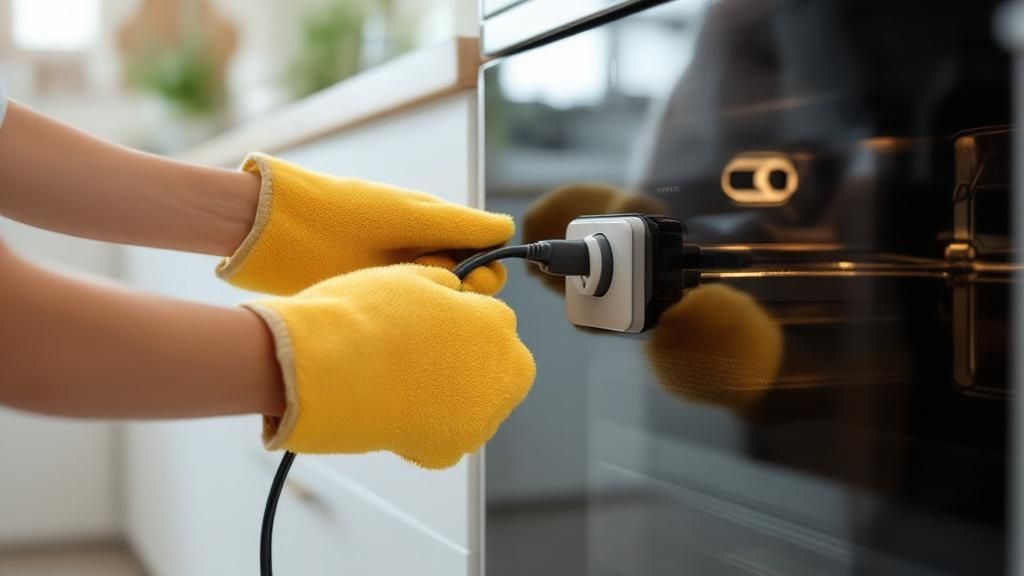
When you discover your oven won’t turn off, your mind probably jumps straight to a faulty thermostat or a shorted-out heating element. Those are common culprits, but before you start diagnosing, your absolute first step is to safely kill the power at the circuit breaker. This isn’t just a suggestion—it’s essential for preventing a dangerous situation and giving you a moment to think clearly.
For homeowners in Austin, TX, a malfunctioning appliance can disrupt your day. That’s why HomeWise Services created a white-glove solution. For just $20, our concierge service connects you directly with a master technician to troubleshoot the issue, recommend the right parts, and even schedule an expert appliance repair in Austin, TX if needed.
The Danger Lurking in a Rogue Oven
There’s a specific kind of panic that sets in when you discover your oven is still roasting away, hours after you thought you turned it off. For homeowners in Austin and beyond, this is more than just an annoyance; it’s a serious safety hazard. An oven that stays on creates a perfect storm for overheating, potential fires, and an energy bill that will make your eyes water. The second you notice something is wrong, you need to act.

It’s not just about the immediate fire risk, either. That constant, intense heat can do a real number on your kitchen. We’ve seen it cause permanent damage to surrounding cabinets and countertops—warping wood, melting laminate, and even scorching stone surfaces over time. Suddenly, a malfunctioning oven becomes a threat to your entire kitchen investment.
Don’t just take my word for it. The statistics are pretty sobering. Major household appliances, with ranges and ovens leading the pack, are linked to more than 150,000 residential fires every single year in the U.S. These incidents result in thousands of injuries and massive property damage. When you consider that many appliance parts are made overseas where quality control can be spotty, you can see why getting this fixed promptly is so critical. For more on the risks, Consumer Reports offers some great insights on appliance fire safety.
This guide will walk you through the usual suspects when an oven goes rogue. But for an issue this serious, getting an expert opinion is always the smartest move.
Expert Tip: I can’t stress this enough: Never try to diagnose or fix an oven while it’s still plugged in or connected to power. Always, always start by flipping the circuit breaker off. Your safety comes first.
Spotting the Common Electrical Culprits
When your oven decides it doesn’t want to turn off, the problem is almost always electrical. Before you can even think about a fix, you have to figure out what’s gone wrong under the hood. For most folks, an electrical fault is the prime suspect, and it usually boils down to one of a few key components giving up the ghost.
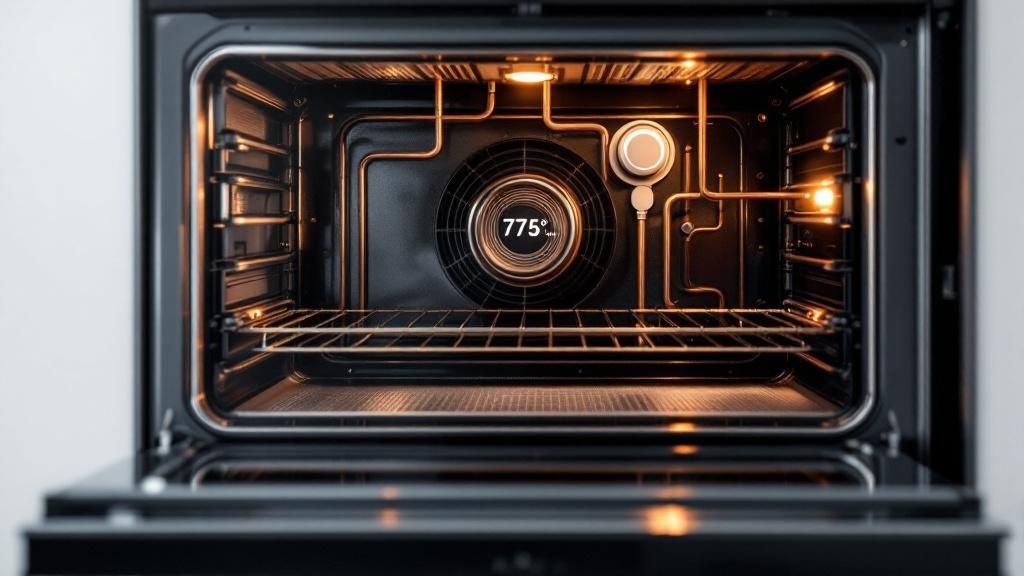
Let’s start with the oven’s “brain” — the control board. This board is covered in little switches called relays that are responsible for sending power to the heating elements. If one of these relays shorts out, it can get stuck in the “on” position. This creates a closed loop, constantly feeding electricity to the element and keeping it red-hot.
Another common offender is the heating element itself, whether it’s the bake element on the bottom or the broil element on top. Over years of heating up and cooling down, these can degrade and short out internally. When that happens, the element essentially creates its own path for electricity, completely bypassing the control board’s commands and refusing to power down.
Doing a Safe Visual Check
Okay, so you’ve shut off the power at the circuit breaker and waited for the oven to cool down completely. Now you can do a quick visual inspection. You don’t need an engineering degree to spot the most obvious signs of trouble.
Here’s what you should be looking for:
- Scorch Marks: Peer at the control board. Any black or brown spots are a dead giveaway of overheating or a short circuit.
- Physical Damage: Take a close look at both the bake and broil elements. Do you see any blisters, cracks, or visible breaks? A damaged element is a classic symptom.
- Loose Connections: Gently wiggle the wires connected to the heating elements and the control board. A loose or burnt-looking wire can definitely cause this kind of chaos.
This initial once-over can often point you straight to the problem. And while you’re in troubleshooting mode, you might find our guide on common kitchen refrigerator fixes useful for other appliance headaches.
A Quick Word on Control Boards: A faulty control board is one of the top reasons an oven stays on. Those little relays that control the voltage can fail and lock the circuit open, sending non-stop power. While a visual check can sometimes show burn marks, a definitive diagnosis often takes a pro with the right tools.
Getting the Right Replacement Parts
If your detective work uncovered a fried control board or a busted heating element, the next mission is finding a replacement. Trust me, grabbing a cheap, low-quality part is just asking for a repeat performance in a few months. You absolutely need components that are an exact match for your oven’s make and model.
For reliable, top-notch replacement parts, we always point people to trusted suppliers like RepairClinic, Parts Select, Sears PartsDirect, and Reliable Parts. They specialize in OEM (Original Equipment Manufacturer) parts, which guarantees a perfect fit and performance you can count on. It’s the best way to make sure your repair actually lasts.
Checking Mechanical and Sensor Failures
If you’ve ruled out the more obvious electrical issues, it’s time to dig a little deeper into the mechanical parts and sensors. A failure here can be trickier to spot than a burnt-out element, but it’s a common culprit when your oven won’t turn off. Essentially, when a mechanical switch or a sensor gives up the ghost, your oven gets stuck in a heating cycle because it never receives the signal to stop.
I see this a lot in older ovens that rely on manual knobs, but don’t count out newer models. These parts simply wear out with time and use, which can lead to some very unpredictable—and frustrating—behavior.
Inspect the Oven Selector Switch
First up is the selector switch. This is the main knob you use to choose a cooking function like bake, broil, or convection. What you don’t see are the small metal contacts inside the switch that complete the circuits for each function. After thousands of twists and turns, these contacts can get worn down, bent out of shape, or even weld themselves together from the tiny electrical arcs that occur during operation.
When a contact gets stuck in the “on” position for a heating element, it will just keep sending power, no matter where you turn the knob. You might have it set to “Off,” but internally, the connection is still live. The result? The oven just keeps on heating.
While a quick visual check might not show anything, the feel of the knob is often a dead giveaway. If it feels mushy, unusually stiff, or doesn’t give you that satisfying “click” as it settles into each position, the switch is probably the problem.
Expert Insight: I’ve been called out to homes in Austin for this exact issue more times than I can count. A selector switch that feels “spongy” instead of crisp is almost always a sign of internal failure. Replacing it is fairly straightforward, but it involves wiring, so I recommend calling a pro if you’re not completely comfortable. For a flat $20, our concierge service can confirm the diagnosis and help you decide if it’s a DIY job or time to call for a professional appliance repair in Austin.
Test the Temperature Sensor
Another critical part is the temperature sensor, which some people call the thermostat. Its only job is to measure the temperature inside the oven and report back to the control board. You’ll typically find it as a thin metal probe sticking out from the back wall of the oven interior.
If this sensor fails, it can start sending wacky readings—or no reading at all—to the oven’s “brain.” The control board, thinking the oven is still ice-cold, will keep pumping power to the heating elements, trying in vain to hit the temperature you set. This is a classic cause of an oven that heats uncontrollably and refuses to shut off.
If you have a multimeter and are comfortable with some basic diagnostics, you can test the sensor yourself.
- Safety First: This is non-negotiable. Unplug the oven and let it cool down completely.
- Testing: Carefully disconnect the sensor and set your multimeter to the ohms (Ω) setting. At room temperature (around 70°F), a healthy oven sensor should give you a reading close to 1,100 ohms.
- Diagnosis: If your reading is wildly different, or if the multimeter shows no continuity at all (an open circuit), the sensor is bad and needs to be replaced.
Should you find a faulty sensor, finding the right replacement is usually easy. We recommend trusted online retailers like RepairClinic or Parts Select to get the correct component for your specific model.
Why Austin Homeowners Choose HomeWise Concierge
When you’re staring down an appliance that’s acting up—especially with the potential safety risk of an oven that won’t shut off—going it alone isn’t always the smartest move. For homeowners here in Austin, trying to guess your way through a complex repair can be a real headache. That’s precisely why we put together a unique service just for our Austin neighbors.
Get a Master Technician on the Phone for Just $20
Instead of falling down the rabbit hole of confusing online forums, what if you could just get a straight answer from a pro? For a flat fee of $20, our HomeWise Concierge Service connects you directly with one of our master technicians. It’s a professional consultation that cuts through the noise and gives you a clear plan.
- Personalized Walkthrough: Our technician will guide you through specific checks to pinpoint exactly what’s causing your oven to stay on.
- The Right Parts, The First Time: We’ll identify the exact component you need and point you toward trusted suppliers like Sears PartsDirect or RepairClinic, ensuring you get a high-quality part.
- Easy Scheduling If You Need It: If the fix is more than you want to handle, we can schedule a trusted, local Austin technician for a true white-glove repair service.
This chart drives home why an expert opinion matters.
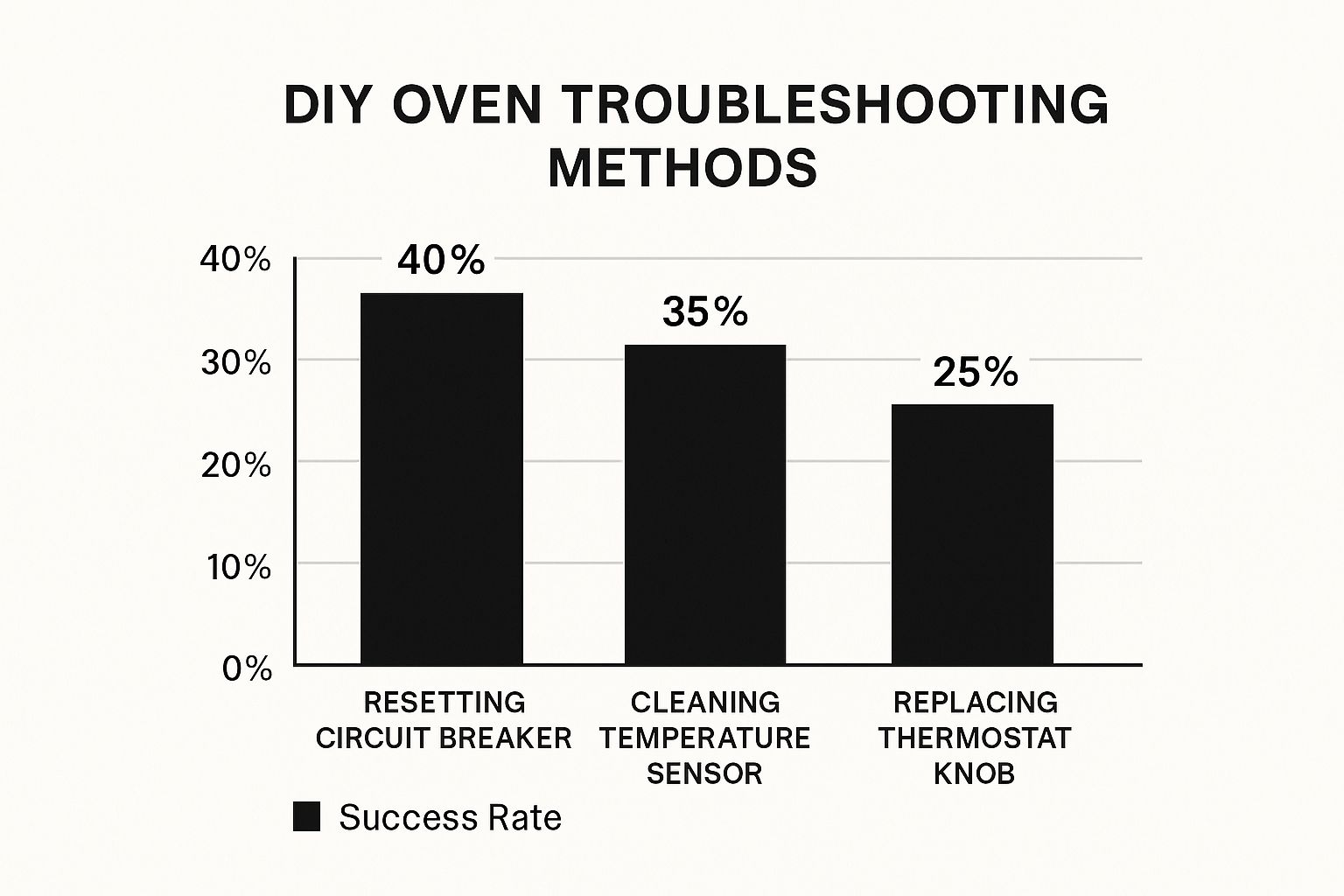
As you can see, even the most common DIY attempts have a success rate of 40% or less. An expert diagnosis from the start saves you wasted time and money. Our concierge service takes the guesswork and stress out of the equation.
Take a look at how our service stacks up against the old-school way of doing things.
HomeWise Concierge Service vs Traditional Repair
| Feature | HomeWise $20 Concierge Service | Traditional Repair Service Call |
|---|---|---|
| Initial Cost | $20 flat fee | $75 – $150+ just for the visit |
| Diagnosis Time | Immediate phone consult | Have to wait for a scheduled appointment |
| Expert Access | Direct access to a master technician | Technician assigned by the company |
| DIY Support | Step-by-step guidance & part identification | No support for DIY; diagnosis only |
| Next Steps | Clear plan for DIY or seamless pro scheduling | You get a quote and have to decide on the spot |
Our goal is to give you a five-star experience from the moment you call. To see everything we offer, feel free to explore the official HomeWise Services website. We’re here to help keep Austin’s homes running smoothly and safely.
Getting Quick Advice and Understanding Modern Safety Features
When your oven refuses to turn off, you need a solution fast. Sometimes, you don’t need a full-service call; you just need a quick, reliable answer from someone who knows their stuff.
Need an Expert Opinion in Minutes?
For those moments, connecting with a verified appliance expert on JustAnswer is a great first move.
For a small fee, you can jump on a live chat or call with a technician who can walk you through diagnosing the problem in real time. It’s an incredibly useful option when you’re feeling stuck and unsure of what to do next. Want instant answers? Connect with experts on JustAnswer for fast, reliable help.
How New Ovens Protect Against Continuous Heating
Appliance manufacturers know how dangerous a runaway oven can be. That’s why many modern ovens come equipped with automatic shutoff features designed to prevent this exact situation. These aren’t just for convenience; they are critical safety mechanisms.
A perfect example is the Energy Saving Mode you’ll find in many newer Samsung ovens. This feature is specifically designed to power down the heating elements after a certain amount of time.
For instance, the broil function on these models automatically stops after three hours, while the baking function is programmed to shut down after 12 hours of non-stop use. This is a built-in failsafe to mitigate the risks of an oven running indefinitely. You can learn more about Samsung’s safety features and how they work.
This highlights a crucial point: an oven staying on for an uncontrolled length of time is a serious malfunction. The fact that modern designs actively work to prevent this underscores why you need to tackle the problem immediately.
If your oven doesn’t have these newer safety features—or if they’ve failed—it just reinforces the need for a fast, accurate diagnosis. Whether you get that instant advice from a pro on JustAnswer or schedule a hands-on diagnosis through our $20 HomeWise Concierge Service, taking action is the only way to ensure your kitchen is safe.
Frequently Asked Oven Repair Questions
An oven that stays on is more than just an inconvenience—it can feel alarming. We get calls all the time from Austin homeowners facing this exact issue. Here are some of the most common questions we hear, with answers to help you navigate this safely.
What is the first thing I should do if my oven won’t turn off?
Your absolute number one priority is safety. If the control panel isn’t responding and you can still see the heating elements glowing red hot, you have to cut the power to the appliance immediately.
Head straight for your home’s circuit breaker panel. You’re looking for the breaker that powers your oven, which is usually a larger, double-pole breaker. Flip it all the way to the “OFF” position. This physically disconnects the electricity, stopping the runaway heating. Once the oven is safely powered down and has had plenty of time to cool, then you can start troubleshooting.
Can I fix an oven that won’t turn off myself?
Honestly, this really comes down to your experience and comfort level with electrical repairs. A handy homeowner can do a quick visual check for obvious problems like burned-out elements.
However, for an oven that won’t shut off, the problem is almost always tied to high-voltage parts like the control board, a shorted bake element, or a failed thermostat. Trying to replace these components without the right know-how is risky. A wrong move could not only wreck the oven for good but also create a serious fire hazard.
For just $20, you can get an expert diagnosis right over the phone with our HomeWise Concierge Service. A master technician can help you pinpoint the issue and decide if it’s a safe DIY project or time for a professional. For immediate advice, you can also try connecting with an expert on JustAnswer.
How much does it cost to fix an oven that won’t turn off in Austin?
The cost can swing pretty widely depending on what’s actually broken. A simple thermostat swap might be on the lower end, but replacing the main control board—the oven’s brain—is typically one of the more expensive repairs. The final bill really depends on the part needed for your oven’s specific make and model, plus the labor to install it.
Getting a professional diagnosis is the only way to know for sure. That’s why our $20 concierge service is such a great starting point. It gives you a clear picture of the potential costs and parts involved before you commit to a full-blown service call. We also offer other affordable options, like our basic subscription plan, to help make home repairs more manageable.
Don’t let a malfunctioning oven become a safety risk in your home. For an expert diagnosis and white-glove repair scheduling right here in Austin, you can trust the pros at HomeWise Services. A portion of our proceeds supports the Texas Amputee Golf and Wellness Foundation, so you’re helping a great cause with every call.
Connect with a HomeWise Services master technician today and get the peace of mind you deserve.
Book Your $20 Concierge Call Now
Article created using Outrank
 HomeWise Services by Master Tech Scott
Leave a comment