Staring at your electric meter can feel like trying to crack a secret code, but knowing how to read your electric meter is probably the single most powerful tool you have for managing your energy bills. This skill is your starting point for double-checking the utility company’s numbers, catching weird energy spikes, and actually seeing the results when you try to conserve power.
Why Reading Your Electric Meter Matters
As Scott Master Tech on JustAnswer, I’ve talked with tons of homeowners across the United States and Canada who feel completely blindsided by surprise utility charges. In my JustAnswer sessions, the number one complaint is a shockingly high bill. The reality is, that little box on the side of your house is telling a story about your home’s energy habits. Once you understand its language, you get to write a better ending.
When you get in the habit of reading your meter, a few things happen:
- You can verify your bill’s accuracy. Let’s be honest, mistakes happen. Comparing your own reading to what’s on your statement is the only way to be sure you’re only paying for the power you actually used.
- You can spot faulty appliances. I’ve seen it time and time again: a sudden, unexplained jump in usage often points directly to a malfunctioning appliance. A failing water heater or an old refrigerator can silently drain power. Finding these “energy vampires” early can save you hundreds.
- You can actually track your savings. When you make a real effort to conserve energy, seeing the numbers on your meter drop is the best kind of positive feedback. It’s what keeps you motivated.
This simple process flow breaks down the core benefits of making this a regular habit.
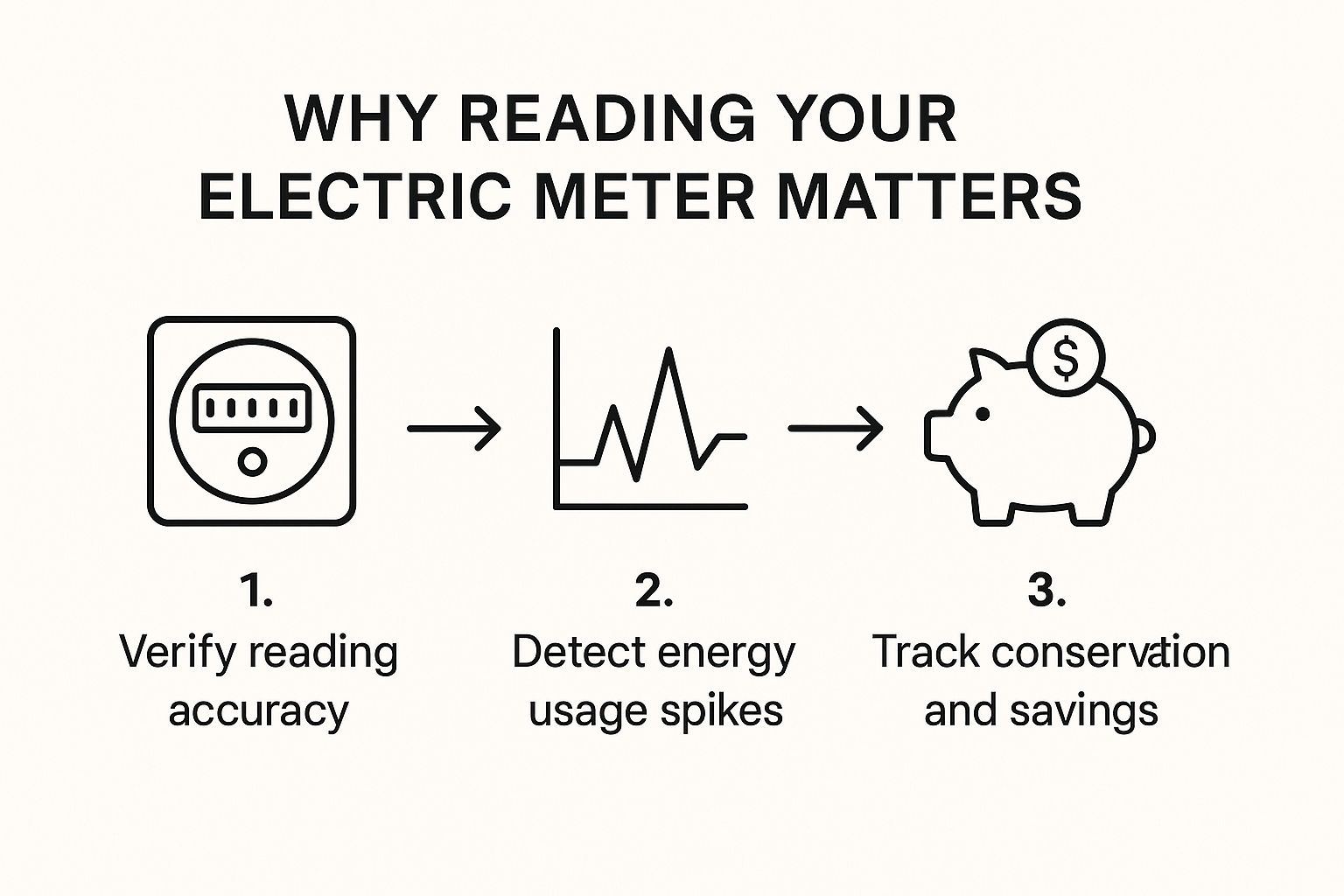
This simple cycle—verify, detect, and track—is what puts you back in the driver’s seat. You stop being a passive bill-payer and become an active energy manager for your home.
Getting a handle on your meter readings is also a must for anyone considering bigger home projects. For instance, you can’t accurately determine the right size solar system for your home without solid data on your real-world consumption. It’s also a foundational step before you start exploring other energy-efficient home upgrades.
I can tell you that nine times out of ten, teaching someone how to read their meter and spot usage patterns is the first step toward fixing a high bill problem. It gives you the power to take meaningful action.
Decoding Traditional Analog Dial Meters
That classic meter with its row of spinning dials might look like something from a bygone era, but they’re still incredibly common. In my JustAnswer sessions, I hear from plenty of homeowners who find them intimidating. I promise, though, they’re much simpler to read than you think once you know the secret.
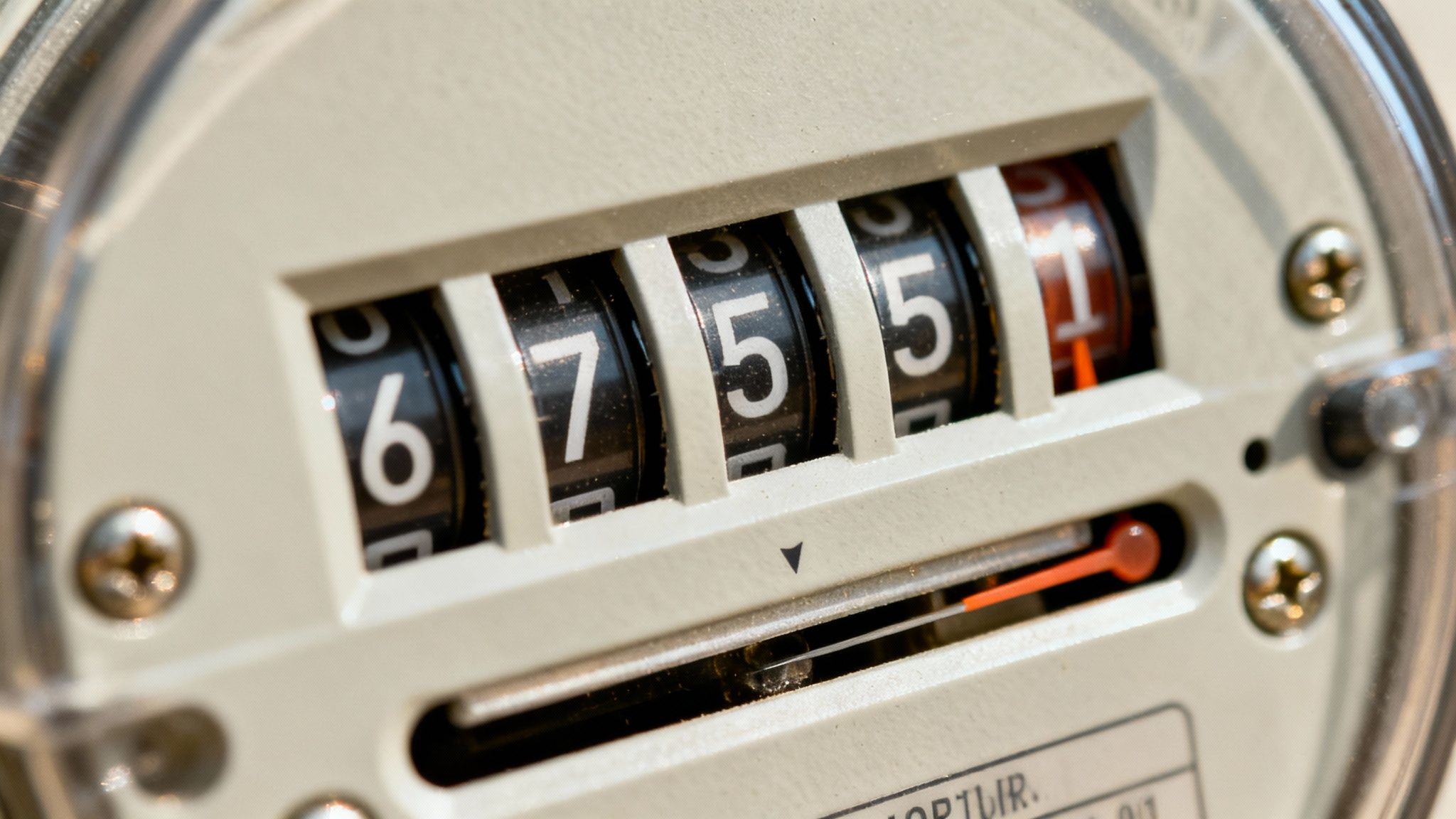
The single biggest mistake people make is reading the dials straight across without accounting for their alternating directions. Look closely—some dials spin clockwise, while the ones right next to them spin counter-clockwise. This is the absolute key to getting an accurate reading.
The Left-to-Right Rule
To get this right, you need to work from the dial on the far left and move toward the right, one dial at a time. It’s a simple process. For each individual dial, you just need to write down the number that the pointer has just passed.
Here’s the golden rule I tell everyone: if the pointer is hovering directly between two numbers, always record the lower of the two. For instance, if it looks stuck between the 7 and the 8, the correct number to jot down is 7. You’ll do this for each dial, and then combine the numbers to get your final kilowatt-hour (kWh) reading.
A Quick Guide to Reading the Dials
To make it even easier, I’ve put together this quick cheat sheet. It’s the same process I walk clients through to help them feel confident about their readings. Following these steps consistently will help you avoid the most common errors.
Quick Guide to Reading Analog Meter Dials
| Dial Position | What to Record | Expert Tip (from Scott Master Tech) |
|---|---|---|
| Pointer is clearly between two numbers. | Record the lower number. | Even if it looks closer to the higher number, if it hasn’t officially passed it, stick with the lower one. No exceptions. |
| Pointer is directly on a number. | Record that number. | But first, check the dial to the right. If that dial’s pointer hasn’t passed zero yet, you have to reduce your number by one (e.g., a 4 becomes a 3). This is the step most people miss! |
Following this process will give you an accurate reading every time.
These electromechanical analog meters have been the standard for decades. Most homes have meters with 5 to 6 dials, and each one represents a single digit in your total energy consumption, which is measured in kWh.
Understanding your meter is a key part of home management, right up there with checking your smoke detectors or cleaning out the gutters. For more tips on keeping your home in top shape, check out my comprehensive seasonal home maintenance checklist.
Making Sense of Your Digital or Smart Meter Display
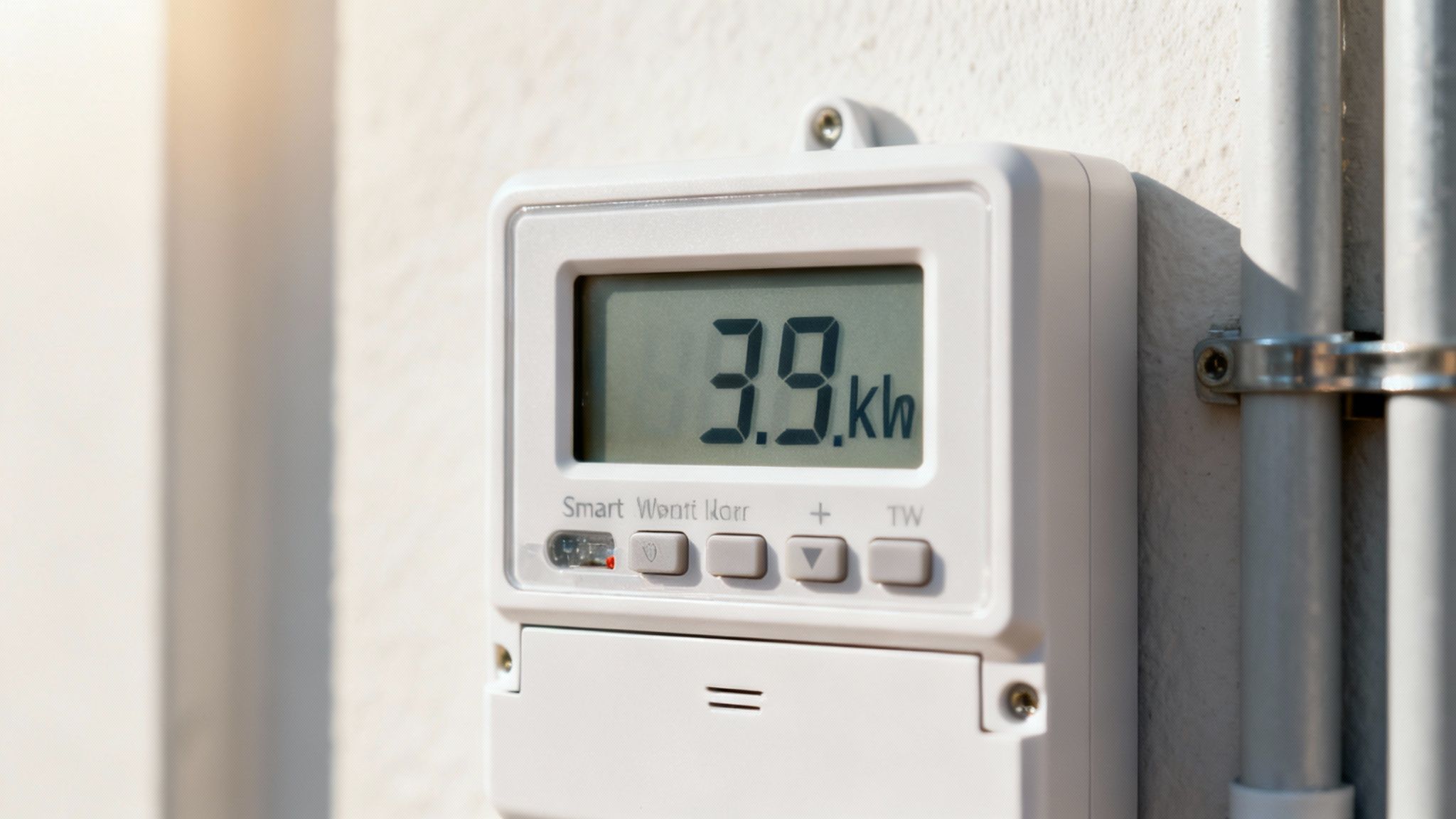
Unlike the old spinning-disc meters, modern digital and smart meters put a ton of information right on an electronic screen. Let’s break down what you’re seeing so you can feel confident tracking your own energy use.
The main number you’re after is your total kilowatt-hour (kWh) consumption—that’s the magic number your utility company uses for your bill. Most digital displays, however, don’t just sit on one screen. They cycle through different readings, like the current power demand in kilowatts (kW), the date, or even a system check screen. Your job is to spot the screen that clearly shows the kWh reading.
Unlocking Your Smart Meter’s Full Potential
The real advantage of a smart meter isn’t just the number on its screen; it’s the data it sends back to your utility provider. This shift from manual to automated meter reading has taken off as utilities across the U.S. and Canada upgrade their grids. These meters use advanced tech to collect usage data remotely, which means no more visits from a meter reader.
This technology is a game-changer because it lets you log into your utility’s online portal and see your energy usage broken down by the hour, day, or week. It’s incredibly useful for hunting down “energy vampires”—those sneaky devices that suck power even when they’re off. If you see a weird spike at 2 a.m. every night, it might be that old TV in the guest room you need to unplug. To get a better handle on how all this works, check out our guide on what smart home technology is.
When the Display Goes Wrong
In my JustAnswer sessions, one of the most common questions I get is what to do when a digital meter’s screen is blank or flashing an error code. It can be alarming, but there’s usually a simple explanation.
Expert Tip from Scott Master Tech: A blank screen doesn’t automatically mean your meter is toast. Before you call the utility company, pop outside and check your main breaker. If the whole house has lost power, that’s your problem. But if the breakers are fine and your neighbors have lights on, the issue is likely with the meter itself, and you should report it right away.
If you see an error code on the screen (like “Err” or a specific number), be sure to jot it down before you call your provider. This little piece of information can help them diagnose the issue much faster.
How to Calculate Your Bill From Your Meter Reading
Alright, you’ve got your meter reading. Now for the satisfying part: turning those numbers into actual dollars and cents. This is the best way to sanity-check your utility bill and get a real handle on where your money is going each month.
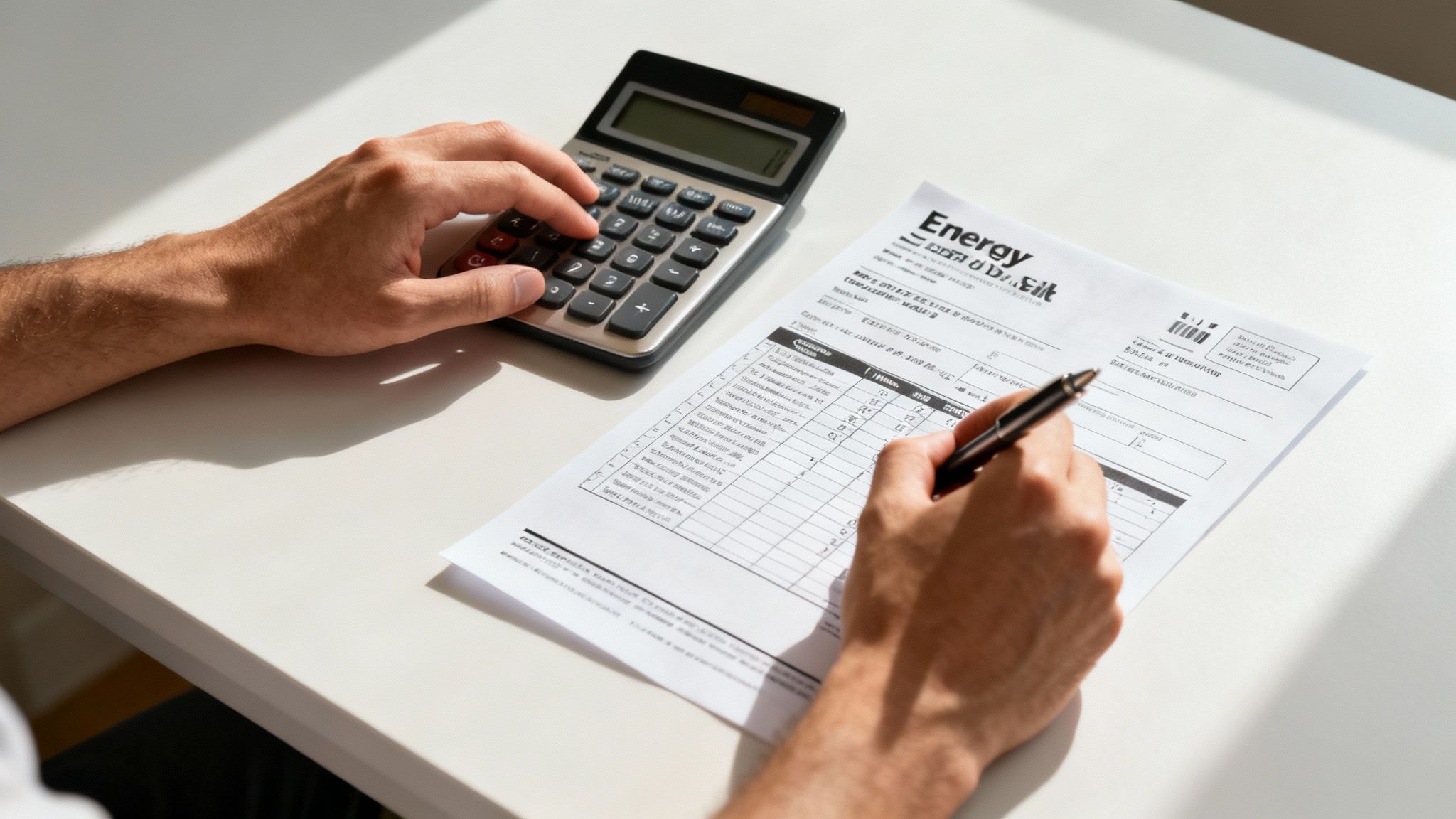
First things first, you need to figure out your total energy consumption for the billing period. It’s pretty straightforward—just take the current reading from your meter and subtract the reading from your last bill. That final number is the total kilowatt-hours (kWh) your home used.
Doing the Math
Once you have your total kWh usage, grab your latest utility bill. You’re looking for the rate your provider charges, which is listed as a cost per kWh.
In a perfect world, the math is simple.
- Simple Calculation: You just multiply your total kWh by the rate. So, if you used 950 kWh and the rate is $0.15/kWh, your bill should be around $142.50.
But let’s be honest, it’s rarely that easy. Many utility companies have more complex pricing structures.
- Tiered Rates: This is a common one. You might pay one price for the first 500 kWh, but then the rate jumps up for any energy used beyond that threshold.
- Time-of-Use (TOU) Rates: With these plans, electricity costs more during “peak” hours (like late afternoons when everyone gets home from work) and less during “off-peak” hours (like the middle of the night).
If you’ve crunched the numbers and your bill still seems way too high, that’s a definite red flag. Our guide on what causes high electricity bills is a great place to start troubleshooting.
Getting a handle on your usage might also get you thinking about ways to cut back. You can explore some essential devices to reduce your electricity bill for some smart, long-term savings.
Troubleshooting Common Meter Problems
Every so often, you’ll glance at your meter and the numbers just won’t make sense, or the display is acting up. In my experience, a sudden, unexplained jump in your electricity usage almost always points back to a single faulty appliance, not a problem with the meter itself.
The usual suspects? I’ve seen it countless times: a malfunctioning water heater or a sump pump that’s stuck in the “on” position. These are notorious energy hogs when they fail.
You can actually play detective here. Head to your breaker box and start flipping off breakers one by one. Keep an eye on the meter as you do. If you see the spinning disc on an analog meter grind to a halt (or the digital display’s usage bar slow way down), you’ve just isolated the power-hungry circuit.
Knowing When to Stop and Call for Help
While a bit of DIY investigation is smart, your safety is what matters most. There are some definite red flags that mean it’s time to put down the flashlight, step away, and call in a professional.
Crucial Safety Warning: Never, under any circumstances, try to open the glass or plastic housing of the meter. Tampering with the meter or the thick main wires feeding into it isn’t just illegal—it’s incredibly dangerous.
If you spot any of these issues, it’s time to get your utility company on the phone:
- Blank or Frozen Digital Display: First, double-check that your main breaker is on and your neighbors still have power. If they do and your screen is still dead, the meter has probably failed.
- Visible Damage: Any signs of burning, melting plastic, or cracked glass on the meter housing are serious. This requires an immediate call to your utility.
- Unexplained Usage Spike: You’ve checked all your major appliances and you still can’t figure out why your usage is through the roof. This could signal a deeper, hidden electrical problem.
Sometimes, these kinds of problems can be traced back to power surges. Taking a moment to learn about what whole house surge protection is is a great way to understand how you can protect your entire home’s electrical system from damage.
If you’ve run through these basic checks and are still scratching your head, don’t leave it to guesswork. A quick 1-on-1 chat with a certified expert on JustAnswer can help you pinpoint the issue in minutes, saving you a lot of time and potentially preventing a costly or dangerous mistake.
Common Questions About Electric Meters
Over the years, whether I’m helping someone on JustAnswer or reading comments on my YouTube channel, the same questions about electric meters come up time and time again. Homeowners everywhere tend to run into the same confusing situations, so I’ve put the most common ones right here with some clear, practical answers.
These are the real-world problems that can leave you scratching your head. Luckily, the solutions are often simpler than you’d think.
What Should I Do If My Meter Reading Seems Way Too High?
This is, without a doubt, the number one question I get. Before you panic and call the power company, take a deep breath and go re-read the meter. Did you accidentally swap a couple of numbers or read a dial backward? It happens to the best of us!
If the reading is definitely correct, it’s time to play detective. Think about your recent power usage. Have you been blasting the AC nonstop during a heatwave? Did you have family staying over for a week? If nothing obvious comes to mind, you can do a quick breaker test to see if something’s pulling power when it shouldn’t be.
Here’s how:
- First, write down the exact numbers you see on the meter. Don’t round up or down.
- Next, head to your breaker box and shut off all the individual circuit breakers. Leave the main one on for now.
- Give it about 30 minutes, then go check the meter again.
If the numbers have ticked up even with everything turned off, you might have an issue with the wiring or the meter itself. That’s when it’s time to call your utility company. If you’re still stumped, an expert on JustAnswer can walk you through how to safely troubleshoot the problem without any of the guesswork.
Is It Normal for My Digital Meter Display to Be Blank?
Absolutely not. A blank digital screen is a big red flag that something is wrong. It almost always points to one of three things: a power outage in your area, a tripped main breaker at your house, or a dead meter.
First, take a quick peek outside. Do your neighbors have lights on? If they do, the problem is likely on your property. Your next stop should be your electrical panel to check if the main breaker has flipped. If the main breaker is fine and your neighbors have power, the meter itself has probably failed. In that case, you need to call your utility company right away to report it.
Can I Request a Different Type of Meter?
That’s a tricky one. The answer really depends on your specific utility provider. Most power companies are in the process of systematically upgrading entire areas to smart meters based on their own schedule. If you still have an old analog dial meter, you can always give them a call and ask what the timeline looks like for your neighborhood.
I also get a lot of questions from homeowners concerned about smart meters who want to opt out. Many utilities do offer opt-out programs, but be prepared for a catch—they almost always come with a monthly fee. This fee covers the cost of sending a technician out to read your meter by hand. You’ll need to contact your provider directly to see what their policies are.
Still have questions or facing a tricky meter issue you can’t solve? Sometimes you just need to talk to a pro. For fast, affordable, 1-on-1 help, you can chat with a certified expert like me on JustAnswer and get the answers you need in minutes.
Get Expert Help with Your Electric Meter Questions Now
I hope this guide helped you feel more confident about reading your meter and managing your home’s energy. Have you ever caught a mistake on your bill or found a faulty appliance this way? Drop a comment below—I’d love to hear your story
 HomeWise Services by Master Tech Scott
Leave a comment