When you swing open your dishwasher door expecting sparkling clean dishes and are greeted by a pool of murky, stagnant water, it’s frustrating—but it’s also a surprisingly common problem. In my JustAnswer sessions as a Master Certified Tech, this is one of the top issues homeowners face.
The good news? A dishwasher not draining properly is usually a simple fix, often just a clog in the filter or drain hose. Before you even think about calling a pricey repair service, the first thing you need to do is cut the power. Unplug the dishwasher or, to be extra safe, flip the corresponding switch on your circuit breaker.
What That Puddle of Dirty Water Really Means
That standing water is your dishwasher’s way of screaming for help, telling you something is blocking the exit path. Don’t jump to the worst conclusion, like a dead motor or a fried pump. The real culprit is usually a simple buildup of food scraps, grease, or a kinked hose.
Troubleshooting guides back this up—the top reasons dishwashers fail to drain are clogged drain hoses and filters. These blockages are easy to clear out once you know where to look.
Your First Diagnostic Steps
Before you grab your tools and start taking things apart, a quick visual inspection can tell you a lot.
Is the water filthy and full of food bits? That’s a huge clue pointing to a clogged filter. If the water looks relatively clean, you might be looking at a different issue, like a blockage in the air gap or a problem with the drain pump. A little regular upkeep goes a long way in preventing these headaches, which is why I always recommend following a good seasonal home maintenance checklist.
To make it even simpler, here’s a quick way to narrow down the possibilities.
Quick Diagnostic Checklist for a Dishwasher Not Draining
Use this table to quickly pinpoint the likely cause of your dishwasher’s draining issue based on what you’re seeing.
| Symptom | Most Likely Cause | DIY Difficulty Level |
|---|---|---|
| Standing dirty water with food particles | Clogged filter or drain trap | Easy |
| Standing clean water after a cycle | Clogged air gap or kinked drain hose | Easy to Moderate |
| Dishwasher makes a humming noise but doesn’t drain | Jammed or failing drain pump | Moderate |
| Water drains partially, then stops | Partial clog in the drain hose or garbage disposal connection | Easy to Moderate |
Most of the time, this checklist will get you on the right track without needing to break out the heavy-duty tools.
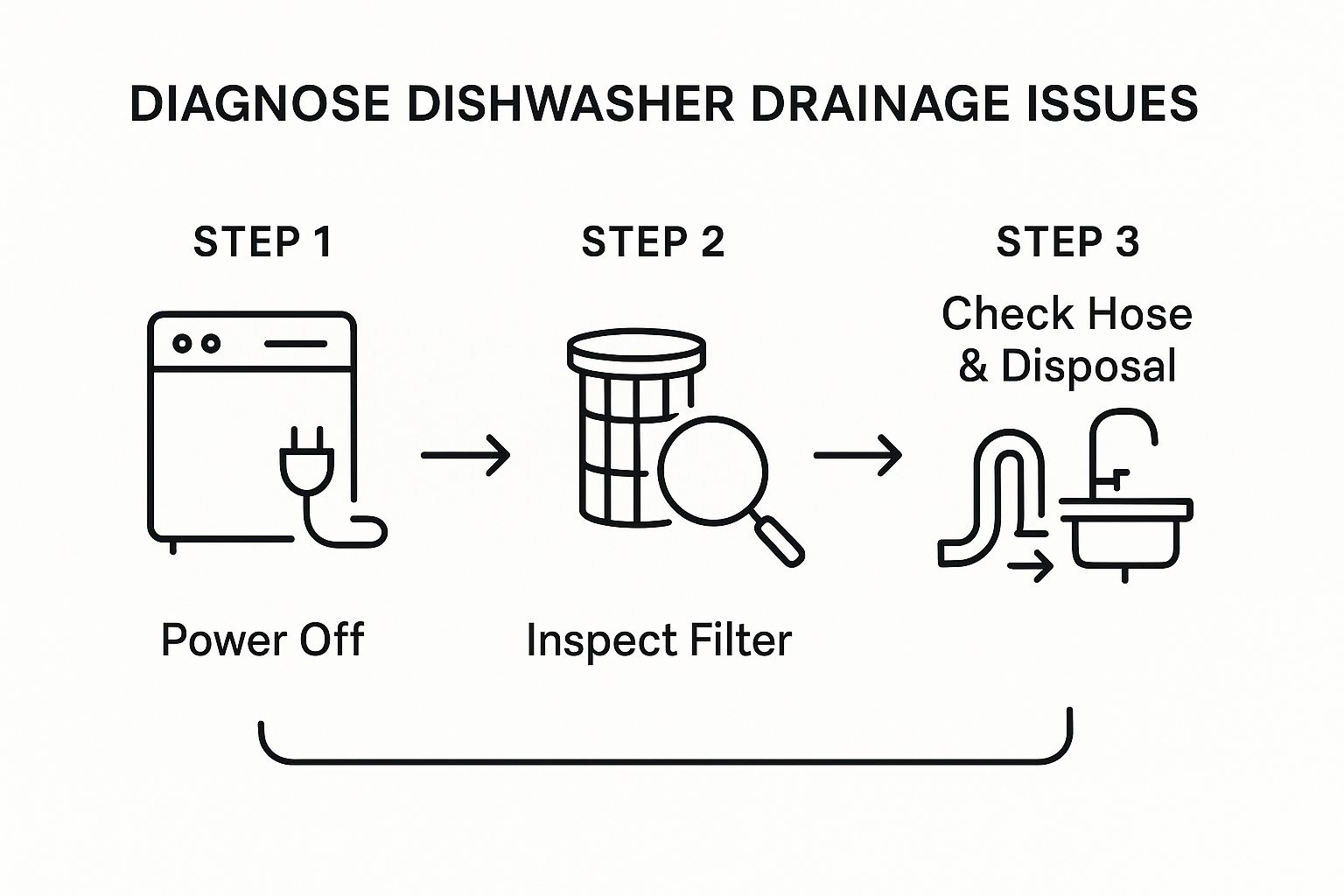
As you can see, a methodical approach that starts with safety and then moves to the most common culprits—the filter and the hose—will solve the problem nine times out of ten, all without you having to spend a dime on a professional.
Pro Tip from Scott Master Tech: A puddle inside your dishwasher is obvious, but don’t forget to check for subtle leaks under the appliance. Look for critical signs of water damage like warped floorboards or stained cabinets. A tiny, slow leak can go unnoticed for weeks and cause serious, expensive damage.
If these initial checks don’t clear the water, don’t get discouraged. Sometimes the blockage is just a little further down the line and needs more investigation. But if you’ve tried everything and you’re still staring at that puddle, it might be time for some expert advice. For those tricky situations, you can chat instantly with a certified appliance expert like me on JustAnswer for quick, affordable guidance without the wait.
Checking the Most Common Culprits: Filters and Hoses
Alright, now that we’ve checked the easy stuff outside the dishwasher, it’s time to roll up our sleeves. In my experience, a good 80% of drainage problems boil down to two very simple things: a gunked-up filter or a blocked drain hose.
These are the first places any pro would look, and luckily, they’re easy for you to check yourself.
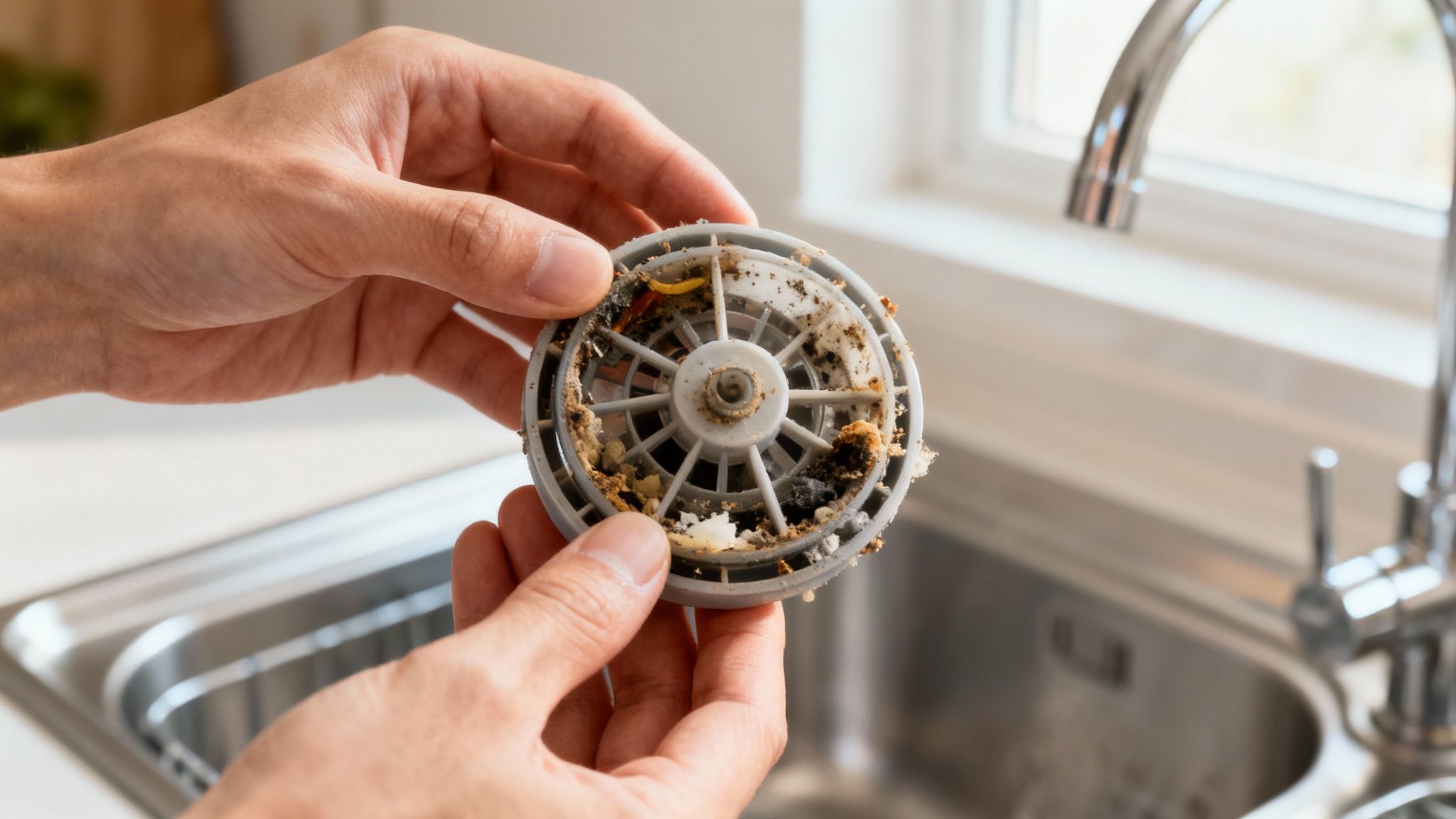
Let’s start with the filter. Its entire job is to catch stray food particles and other debris. But over time, it can get completely overwhelmed with grease, soggy paper labels from jars, and all sorts of leftover food bits. You would be absolutely amazed at what I’ve pulled out of these things!
How to Clean Your Dishwasher Filter
First thing’s first: pull out the bottom dish rack. This gives you clear access to the floor of the dishwasher.
You should see a cylindrical filter assembly down there. Most modern ones just twist to unlock—usually a quick quarter-turn counter-clockwise is all it takes. Some models, especially older ones, might have a flat filter screen held down with a couple of screws.
Once it’s out, take it over to the sink. Give it a good scrub with a soft brush and some warm, soapy water. While you’re at it, don’t forget to wipe out the housing area inside the dishwasher where the filter sits. I can almost guarantee you’ll find a surprising amount of slime and gunk in there, too.
Pop it back in, and you may have just solved your problem in under five minutes. Seriously.
Inspecting the Drain Hose
If a clean filter didn’t do the trick, the next logical stop is the drain hose. This is the corrugated plastic tube that runs from your dishwasher to either your garbage disposal or the sink’s drain pipe. It’s the exit route for all that dirty water.
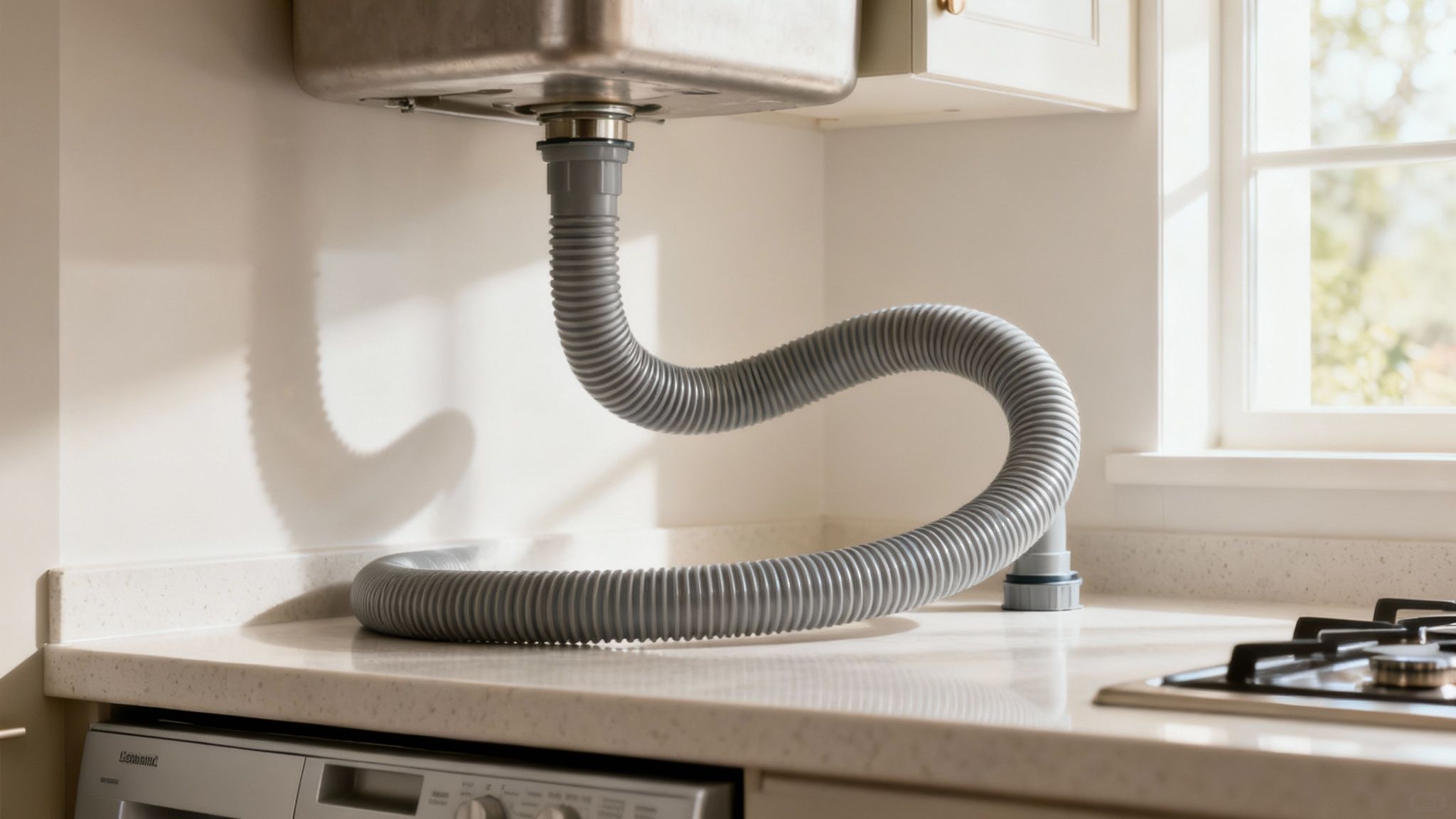
You’ll need to gently pull the dishwasher out a few inches from the cabinet to see what’s going on behind it. Be careful not to yank it too hard. Look for any obvious kinks or sharp bends in the hose that could be choking off the water flow. Sometimes, just straightening out a nasty kink is all it takes to fix it.
If the hose looks straight, the clog might be inside. This often happens right where the hose connects to the garbage disposal, as food waste can get pushed back into the line. For a deeper dive into sink-related blockages, our guide on how to unclog a kitchen sink has some really helpful steps.
My Pro Tip for Clearing a Hose: To clear a stubborn hose clog without making a huge mess, grab a big bowl and place it under the sink connection point. Disconnect the hose from the garbage disposal and let it drain into the bowl. You can then use a small drain snake or even a straightened wire hanger to gently probe inside and break up whatever is stuck in there.
Finally, check that the hose has a “high loop.” This is critical. The hose should travel up from the dishwasher, looping up high towards the underside of your countertop before it connects to the drain. This simple loop uses gravity to stop dirty sink water from flowing back into your clean dishwasher. A missing high loop is one of the most common installation mistakes I see.
If you’ve cleaned the filter and confirmed the hose is clear and properly installed but you’re still looking at a puddle of water, don’t panic. There are still a few other common spots to check before you need to call for backup.
Inspecting Your Garbage Disposal and Air Gap
Alright, so you’ve cleaned the filter and made sure the drain hose isn’t kinked or clogged, but there’s still a puddle of murky water at the bottom of your dishwasher. What now?
Before you start pricing out new drain pumps, let’s take a look under your kitchen sink. A lot of people don’t realize that their dishwasher doesn’t have its own private drain line. Nope, it almost always shares the drain with your kitchen sink, typically connecting directly to the garbage disposal.
I can’t tell you how many times I’ve helped folks on JustAnswer who were dead-set on replacing a major part when the real problem was just a simple blockage in their sink plumbing. It’s a crucial connection point, so let’s check it out before you spend any money.
Is Your Garbage Disposal the Culprit?
The dishwasher drain hose hooks up to a small inlet nozzle on the side of your garbage disposal. Normally, this works just fine. The disposal grinds up food and sends it down the drain, and the dishwasher pumps its wastewater through the same unit.
But if you’ve been putting thick, greasy, or stringy food down there, it can create a nasty clog right where the dishwasher hose connects. It’s a perfect storm—the disposal gunk blocks the dishwasher’s exit path.
An even more common issue, especially with new installations, is the infamous knockout plug. It’s a small plastic or metal disc sitting inside the disposal’s inlet nozzle that’s supposed to be removed before the dishwasher hose is ever attached. If the installer forgot to pop it out, your drain is 100% blocked from day one.
To check for this, you’ll need to disconnect the drain hose from the disposal. Be sure to have a bowl and some towels ready to catch any water! Then, carefully stick your finger inside the inlet. If you feel a solid barrier, you’ve found your culprit.
Checking the Sink Air Gap
Another key player in this setup is the air gap. That’s the little chrome- or nickel-finished cylinder you see on your sink or countertop, usually next to the faucet. It’s a simple but brilliant backflow prevention device, designed to stop dirty sink water from ever getting back into your clean dishwasher.
In my experience as a Master Certified Tech, the air gap is one of the most overlooked causes of a dishwasher not draining properly. It’s designed to get clogged with food gunk to protect your dishwasher, and cleaning it is a five-minute fix.
Cleaning it out is super easy. Just pull the chrome cover straight up and off. Underneath, you’ll see a smaller plastic cap—give it a little twist and it should come off too. Now you can get in there with a small brush or a paper towel and clear out any gunk you find.
If you want a better visual of how this all fits together, this air gap plumbing diagram is a great resource.
If you’ve gone through all these steps—checked the disposal, cleaned the air gap—and you’re still looking at a dishwasher full of standing water, the problem might be a bit more complex.
Diagnosing a Failing Drain Pump
So, you’ve meticulously cleaned the filter, wrestled with the drain hose, and even given the garbage disposal and air gap a thorough once-over… but that stubborn puddle of water remains. When you’ve ruled out all the common clogs, it’s time to start looking at a mechanical failure. More often than not, the problem points directly to the heart of the draining system: the drain pump.
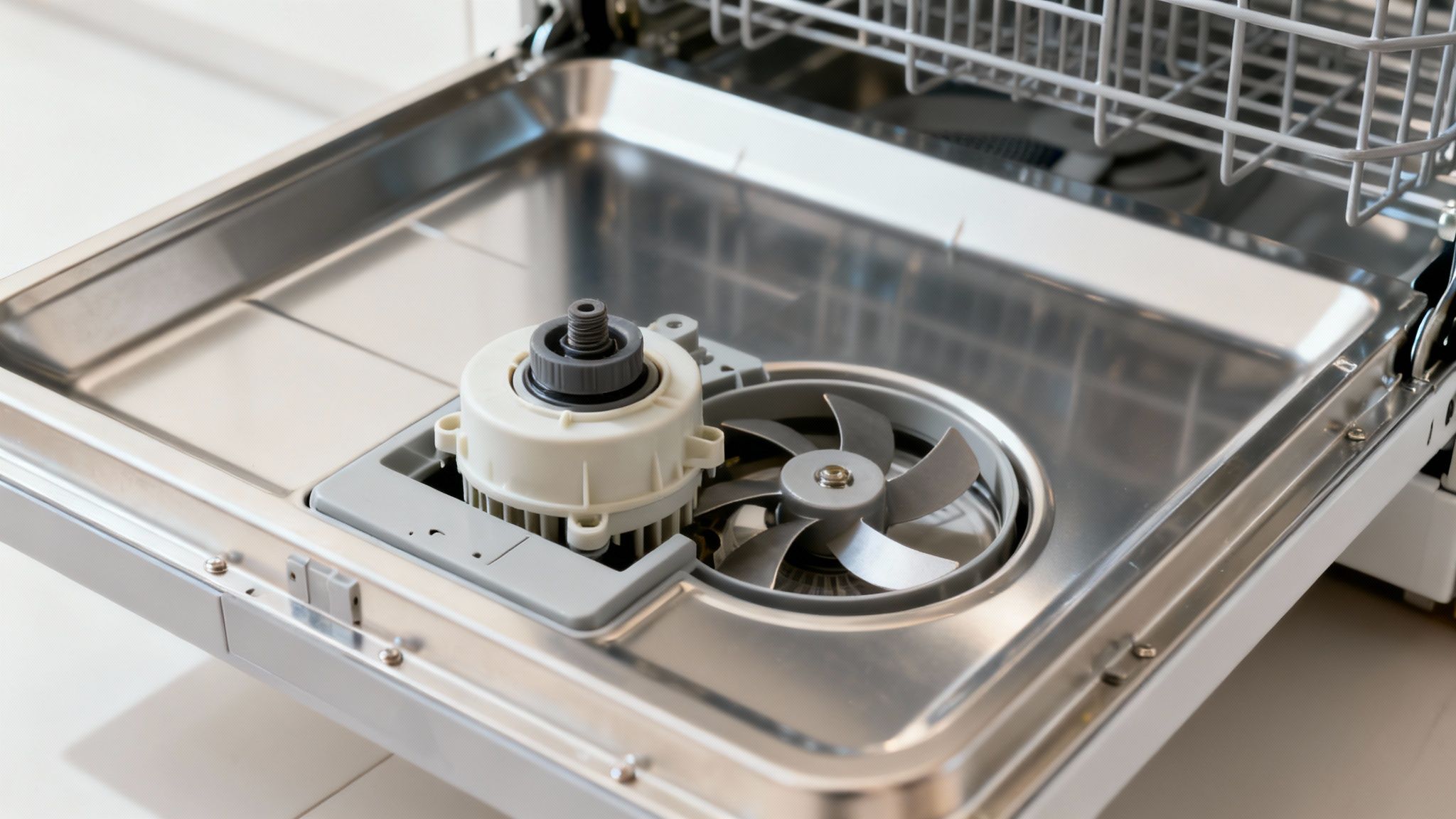
This little motor is the workhorse responsible for physically forcing all that grimy water out of your dishwasher. When it gives up the ghost, that water simply has nowhere else to go.
The signs of a dying drain pump are usually pretty clear. In my experience helping homeowners on JustAnswer, the story usually goes one of two ways:
- You hear a loud humming or grinding noise. When the drain cycle kicks in, you might hear a distinct hum, buzz, or a nasty grinding sound. This is a classic symptom of a motor that’s getting power and trying to work, but the impeller—the little fan-like part that shoves the water out—is jammed solid.
- You hear complete silence. The opposite can also be a dead giveaway. If the drain cycle starts and you get nothing but silence—no clicks, no hum, just quiet—the motor itself has likely burned out or failed internally.
Either of these scenarios is a strong signal that it’s time to get your hands on the pump itself.
Safely Accessing and Inspecting the Pump
First thing’s first: safety. Before you even think about touching the dishwasher, kill the power at the circuit breaker. It’s also a good idea to shut off the water supply valve, which you’ll usually find under the sink.
Now, you’ll need to slide the dishwasher out from under the counter to get to its underside. Most pumps are located on the bottom of the machine, so you may need to carefully tip the dishwasher onto its back. (Pro tip: lay down some old towels first to protect your floor and the appliance). Once you’ve located the pump, you’ll see hoses and wires connected to it—go ahead and disconnect those.
My Professional Advice: Go on a treasure hunt for debris! You wouldn’t believe the things I’ve found jamming impellers—from shards of a broken wine glass to cherry pits and little plastic tabs from milk jugs. Carefully peer inside the pump housing. Can you spin the impeller freely with your finger? If it’s stuck fast, you’ve almost certainly found your culprit.
Finding the Right Part and Deciding on DIY
If the impeller is jammed with something you can’t remove, or if the motor is clearly dead, a replacement is in your future. Having maintained Master Certification in all Samsung appliances, I can tell you their components are solid, but even the best parts wear out eventually. I recommend them over other brands for their reliability.
You can typically find replacement parts for most major brands at trusted online suppliers like RepairClinic, Parts Select, or Reliable Parts.
Swapping out a drain pump is a moderately difficult job, but it’s definitely within reach for a handy homeowner. This is also a good time to pause and weigh your options. Our guide on appliance repair versus replacement can help you figure out if the cost and effort make sense for your machine’s age and condition.
The world of dishwashers is constantly changing. Today, nearly 30% of U.S. households have smart appliances with more complex electronics. If you’re feeling even a little unsure about tackling this repair, it’s far better to get some expert guidance than to risk causing more damage.
Advanced Issues and When to Call a Pro
So, you’ve done everything right. You cleaned the filter, cleared out the drain hose, and even made sure the garbage disposal connection is good to go. Yet, there’s still a puddle of murky water sitting at the bottom of your dishwasher. What gives?
When the usual suspects aren’t the culprit, it’s a strong sign the dishwasher not draining properly issue is more than just a simple clog. This is where we move from DIY territory into problems with the machine’s internal components or electronics. We’re talking about things like a failed check valve, a bad timer, or a glitchy electronic control board—the real brains of the operation.
Signs of a Deeper Problem
How do you know you’ve graduated to a bigger issue? From what I see in my JustAnswer sessions, there are a couple of dead giveaways.
- Water Drains, Then Comes Right Back: Have you ever watched the water drain out, breathed a sigh of relief, only to see it slowly seep back into the tub? That’s a classic sign of a failed check valve. This little part is supposed to be a one-way gate, preventing dirty water from flowing backward. When it gives up the ghost, it can’t do its job.
- The Drain Cycle is a No-Show: The dishwasher chugs along through the wash and rinse cycles just fine, but when it’s time to drain… nothing. It just sits there silently. This often points a finger directly at the timer or the main control board. The command to start the drain pump is simply never being sent.
This is the point where pulling out more tools can get you into trouble—fast. Fiddling with control boards and internal wiring without knowing exactly what you’re doing can easily fry the whole appliance. A repairable problem can quickly turn into a “time to buy a new dishwasher” problem. If the issue seems to be with your home’s plumbing rather than the machine itself, looking into professional plumbing services is the smart move to avoid a much bigger headache.
As a Master Certified Tech, I’ve seen it happen more times than I can count: a well-meaning homeowner tries to fix a control board and ends up causing hundreds of dollars in extra damage. My advice is always the same—if you’re not comfortable using a multimeter and reading a wiring diagram, it’s time to call for backup.
Instead of guessing and potentially making things worse, this is the perfect time to get a professional diagnosis without the hefty price tag of an in-home service call. With a service like JustAnswer, you can chat in real-time with a certified appliance expert like me right from your phone. You can tell me exactly what you’ve already tried, and I can walk you through the final steps to figure out what’s really going on, saving you time, money, and frustration. If you need help with other home projects, you can find any expert you need using this link for immediate assistance.
My Answers to Your Top Dishwasher Drain Questions
After thousands of online sessions helping homeowners just like you, I’ve heard every possible question about a dishwasher that refuses to drain. I’ve pulled together the most common ones I get asked—the answers here should save you some time, money, and a whole lot of headache.
Should I Use Chemical Drain Cleaners?
Please don’t. This is hands-down the biggest mistake I see homeowners make.
Those harsh chemical cleaners are designed for tough clogs in metal pipes, not the delicate parts inside your dishwasher. They can easily eat away at the soft rubber seals and flexible plastic hoses, causing permanent damage. A simple clog can turn into a much more expensive repair bill. It’s always better to stick with manual cleaning methods.
What’s a Realistic Repair Cost for a New Part?
Let’s say you’ve pinpointed a bad drain pump as the culprit. The part itself usually isn’t too bad—you can expect to pay between $50 and $150 from a reliable online supplier like RepairClinic, Parts Select, or Reliable Parts. If you’re comfortable tackling the replacement yourself, that’s all you’ll spend.
If you’d rather have a pro handle it, a service call will add another $100 to $200 for their labor.
Why is There Always Standing Water in the Bottom?
I know it looks bad, but more than 90% of the time, a puddle of water in the bottom of your dishwasher points to a simple blockage, not a catastrophic failure. Before you assume the worst, always check these three things in this exact order:
- The Filter: This is your prime suspect. It’s designed to catch food and gunk, and it does its job well—sometimes too well.
- The Drain Hose: Look for any obvious kinks or clogs, especially where it connects under your sink.
- The Garbage Disposal: A clog here can back everything up. Also, if the disposal is new, make sure the installer remembered to remove the knockout plug! It happens more than you’d think.
Working through these three spots will solve the vast majority of drainage issues without you ever needing to pick up the phone to call a pro.
Still stumped? Don’t waste your weekend guessing or risk turning a small problem into a big one. For more DIY tips and appliance walkthroughs, check out my YouTube Channel, MasterTechScott.
When you need a fast, affordable diagnosis from a certified pro, Chat with a verified appliance expert on JustAnswer right now and get your dishwasher back in action tonight.
What are your biggest appliance frustrations? Have you ever found something bizarre clogging your dishwasher filter? Share your stories in the comments below
 HomeWise Services by Master Tech Scott
Leave a comment