When you discover your AC unit is not cooling your house, it’s easy to jump to the worst conclusion. But more often than not, the problem is something simple you can fix yourself—an incorrect thermostat setting, a tripped circuit breaker, or a clogged air filter.
Before you start worrying about a hefty repair bill, taking a few minutes to check these three basic areas can often solve the problem and save you the cost of a service call. If you’re stuck, I’ll show you how to get instant, affordable help from a certified expert like me.
Your First Diagnostic Checks for a Warm AC
It’s the first truly hot day of the year, and you suddenly realize your AC is just pushing warm, stale air around. As a Master Certified Tech, I hear this exact scenario all the time in my JustAnswer sessions. My first piece of advice is always the same: don’t panic. Start with the basics.
You’d be surprised how many cooling failures come down to a minor oversight that any homeowner can fix themselves. Think of this as your essential first-response checklist. We’re going to rule out the simple culprits first, which honestly account for a huge number of “my AC isn’t working” complaints.
Start With The Obvious Suspects
Your first stop should always be the thermostat. I know, it sounds too simple to be true, but you’d be amazed how often the settings are the root of the problem.
- Check the Mode: Is it actually set to “Cool”? Sometimes it gets accidentally switched to “Heat” or just “Fan.”
- Verify the Temperature: For the AC to even try to kick on, the set temperature needs to be at least a few degrees lower than the current room temperature.
- Inspect for Power: If the thermostat has a blank screen, it might just need new batteries. Many digital models run on them, and a quick swap could be all it takes.
Next up, head to your home’s electrical panel. An air conditioner is a high-power appliance, and it’s not uncommon for it to trip a breaker, especially during a power surge or when it first starts up after a long winter off-season. Find the breaker for your AC or air handler, flip it completely off, and then firmly back on.
This infographic gives you a quick visual of how these first few checks flow together before you need to dig any deeper.
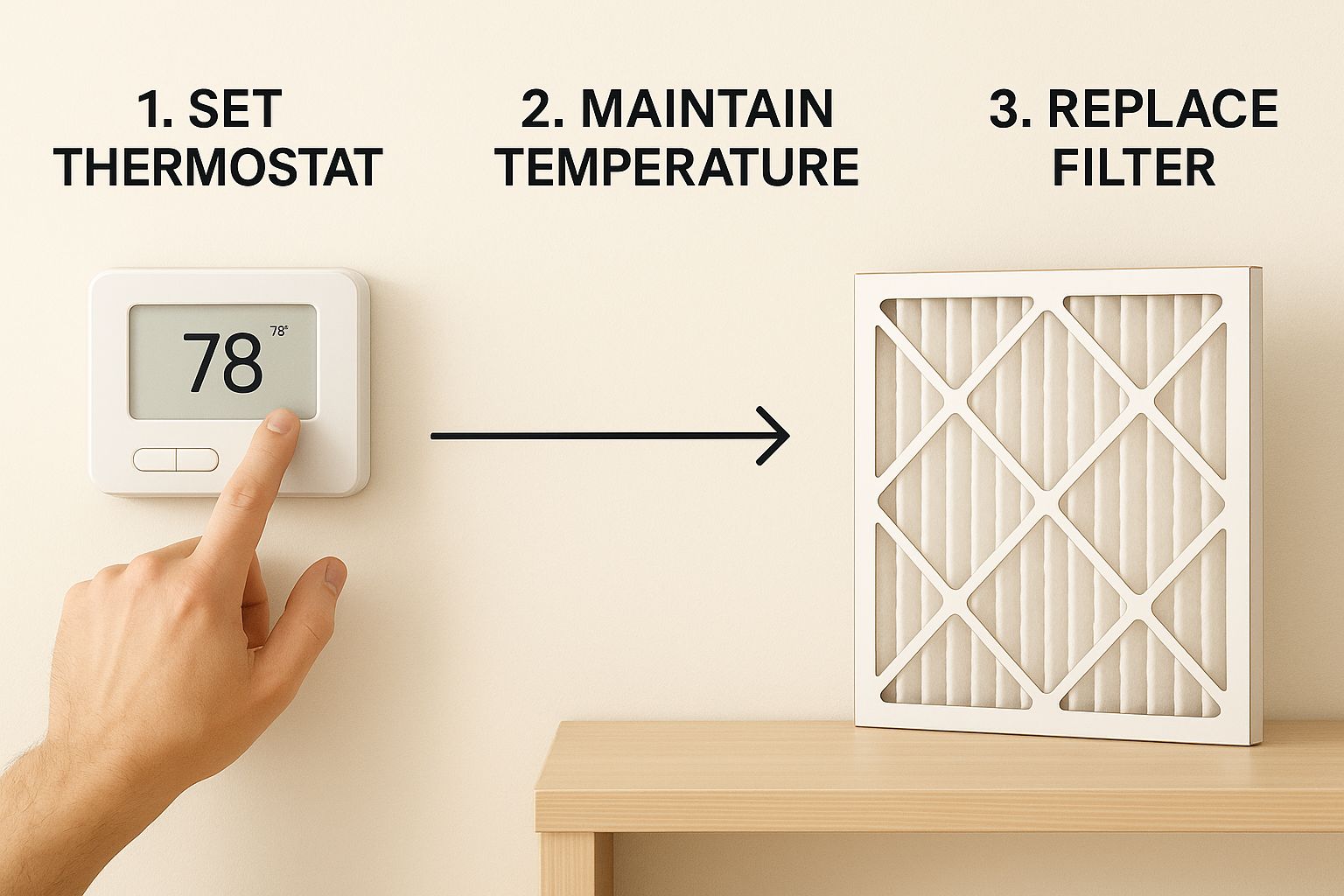
As you can see, the thermostat and air filter are the foundational first steps for any AC diagnostic.
Finally, let’s talk about the single most common offender: a dirty air filter. A clogged filter essentially suffocates your system. It drastically reduces airflow and makes it impossible for cool air to circulate through your home.
This simple task is a critical part of any good seasonal home maintenance checklist and really should be done every 1-3 months.
To make this even easier, here’s a quick summary of these initial DIY steps.
Quick DIY AC Diagnostic Checklist
Before calling for help, run through this simple table. These three checks cover the most common issues and can save you a lot of time and money.
| Symptom | Potential Cause | DIY Action | Difficulty |
|---|---|---|---|
| AC won’t turn on or is blowing warm air | Incorrect thermostat setting | Verify it’s on “Cool” and the set temp is below the room temp. Check batteries. | Beginner |
| System is completely dead (no lights, no sounds) | Tripped circuit breaker | Locate the AC breaker in your electrical panel. Flip it off, then back on. | Beginner |
| Airflow from vents is weak and not very cold | Clogged air filter | Locate and replace your furnace/air handler filter. | Beginner |
If running through this checklist gets your cold air flowing again, great! You just saved yourself a bundle. If not, don’t worry—we have more steps to cover.
Inspecting Your Outdoor Condenser Unit
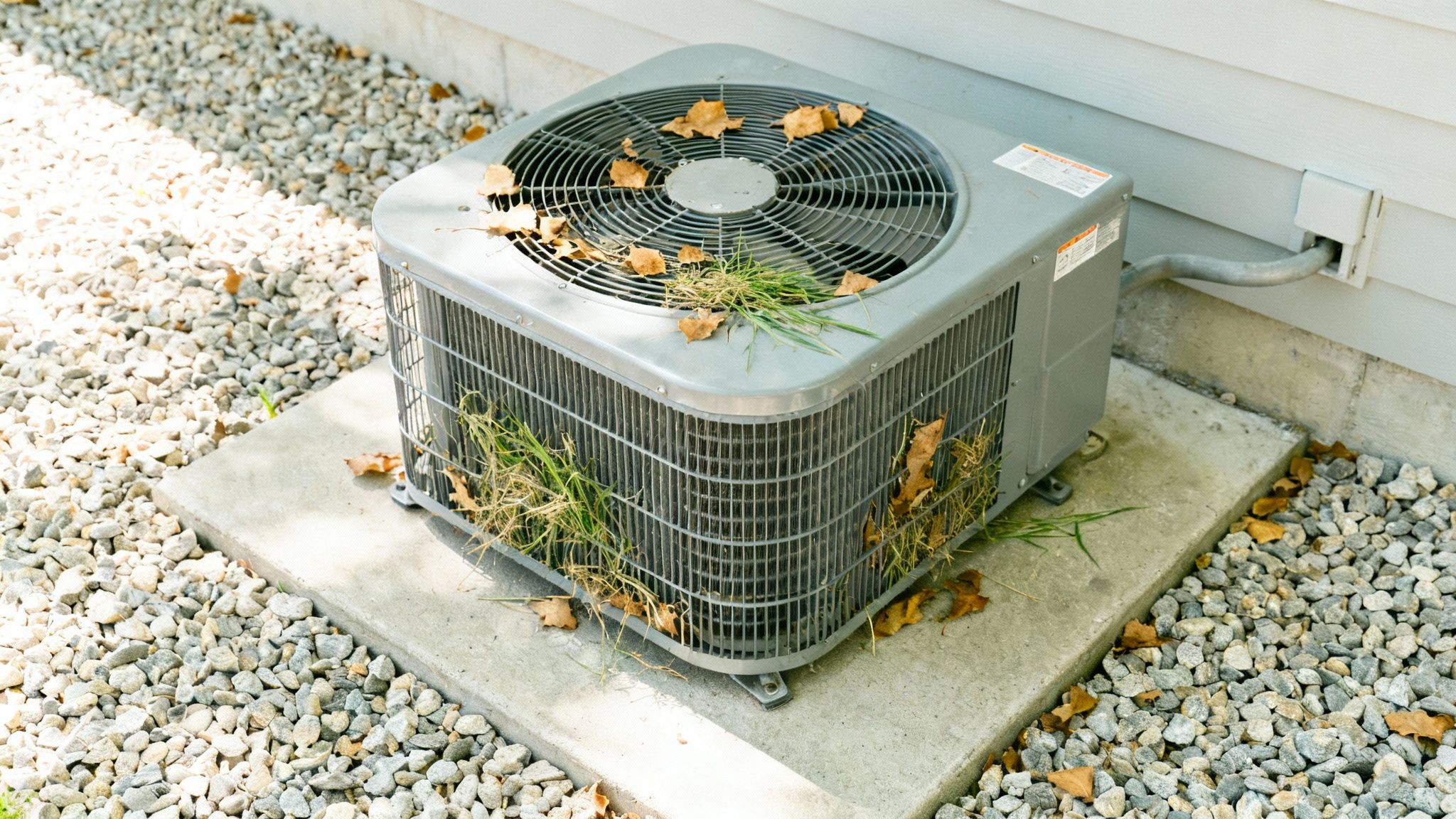
If the simple checks inside your home didn’t get the cool air flowing again, it’s time to head outside. That big metal box with the fan on top is your condenser, and its whole purpose is to dump all the heat it pulled from your house into the outside air. When something gets in the way of that process, the heat gets trapped, and your house stays warm.
You’d be surprised how many cooling problems I troubleshoot on JustAnswer that boil down to a dirty or blocked condenser. But before you touch anything, the absolute first step is safety. Go to your circuit breaker panel and shut off the power to the AC. Then, find the outdoor disconnect box—usually a smaller metal box on the wall near the unit—and pull the handle or switch it off. Never skip this.
Clear Debris and Give It Space
The condenser is basically a giant radiator for your house. A big fan pulls air through hundreds of thin metal fins to release heat. If those fins are clogged with dirt, grass clippings, cottonwood fluff, or leaves, the unit simply can’t breathe.
- Look for Blockages: Start by gently clearing away any obvious debris like leaves and twigs. A soft brush or a shop vac with a brush attachment works great for this.
- Create a Buffer Zone: Your unit needs room to work. Make sure you have at least two feet of clear space on all sides. That means trimming back overgrown bushes, weeds, or anything else crowding it.
- A Gentle Rinse: If the fins are caked in grime, you can use a garden hose on a light spray setting to wash them down. But be careful—never use a pressure washer. You’ll bend those delicate aluminum fins flat and cause a much bigger, more expensive problem.
While you’re out there, take a look for any physical damage. Dents from a lawnmower or hail damage can crush the fins and choke off airflow just as badly as dirt can.
Master Tech Tip: When you’re rinsing the fins, try to spray from the inside out (if you can safely remove the top fan grille). If not, spray from the outside at an angle. This pushes the gunk out the way it came in instead of packing it deeper into the coil.
Listen for Trouble
Once you’re done cleaning, restore the power and just listen for a minute. The sounds your condenser makes are huge clues to its health.
Does the fan spin up quietly and smoothly? If you hear squealing or grinding, the fan motor might be on its last legs. If the fan isn’t moving at all but you hear a distinct humming or buzzing, that’s a classic sign of a bad capacitor—a very common and relatively easy fix.
Next, listen for the compressor, which is the heart of your AC system. A healthy one produces a steady, low hum. If you hear loud banging, clanking, or rattling noises, shut the system down at the breaker immediately. Those are signs of a serious mechanical failure brewing.
If a good cleaning doesn’t bring back the cold air, or if you hear any of those troubling sounds, the issue has moved beyond basic maintenance. You’re likely dealing with a failed component.
Don’t start guessing and risk more damage. For just a few dollars, you can chat live with a certified technician like me on JustAnswer for fast, expert advice. We can walk you through further diagnostics to pinpoint the exact problem. And for future reference, check out my guide on how to maintain your HVAC system to help keep things running smoothly.
Diving Into Your Indoor Air Handler
Alright, we’ve given the outdoor unit a good once-over. Now it’s time to head inside and look at the heart of your cooling system: the air handler. This is where the real cooling magic happens, but it’s also where some of the most common gremlins hide out when your ac unit is not cooling your house.
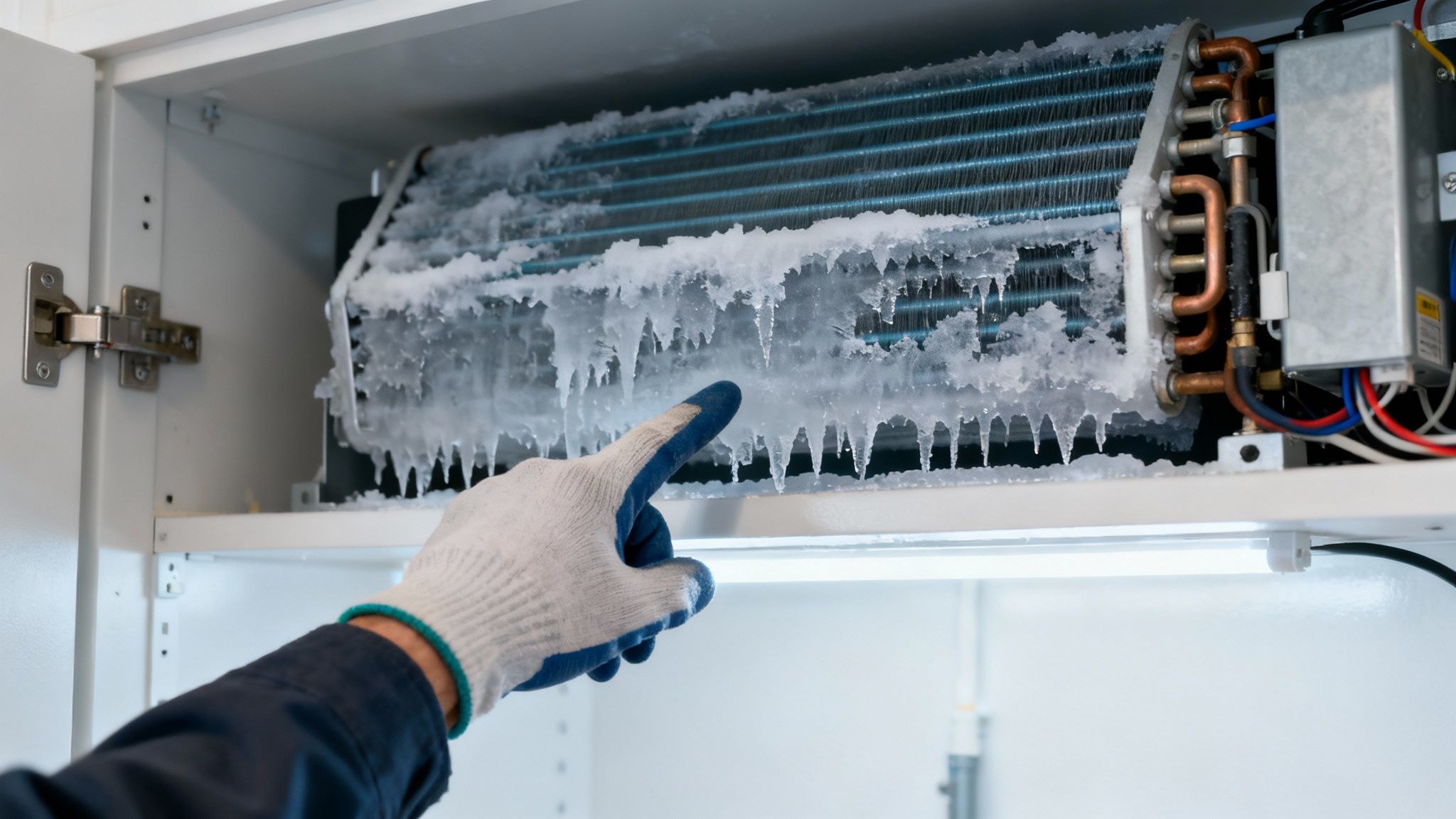
One of the issues I diagnose constantly in my JustAnswer sessions is a frozen evaporator coil. It’s a jarring sight, finding a solid block of ice inside your AC, but it almost always points to one thing—an airflow problem. And you guessed it, this often leads right back to the dirty filter we talked about earlier.
The Dreaded Frozen Evaporator Coil
Your evaporator coil’s one and only job is to pull heat out of your home’s air. For that to work, it needs a steady stream of warm air flowing over it. When that airflow gets choked off, the coil gets way too cold, and the condensation that normally forms on it freezes solid.
Master Tech Tip: If you see ice on your coils, you must thaw it out before you do anything else. Head to your thermostat and turn the AC cooling off, but leave the fan set to “On.” This forces room-temperature air over the ice to melt it down safely. Be patient; this can take a few hours, but it’s the proper way to handle it.
Once everything is thawed out, you can play detective. Double-check that filter. Are all the vents and registers in your house open and not blocked by furniture or rugs? I’m telling you, poor airflow is the culprit 99% of the time. For a more detailed guide, run through my complete HVAC system maintenance checklist to make sure you’ve covered all the bases.
Clearing a Clogged Condensate Drain Line
As your AC pulls humidity from the air, that water has to go somewhere. It drips into a pan and flows outside through a condensate drain line. Over time, this line can get gunked up with algae and sludge, causing a clog.
Most modern air handlers have a safety float switch. If the water backs up, this switch will shut the entire system down to prevent a nasty overflow. So, a simple clog can make it look like your entire AC unit has died.
Here’s how you can try clearing a minor clog yourself:
- Find the Drain Line: Look for the PVC pipe coming out of your indoor unit. You’ll usually see a T-shaped section with a cap on it right near the air handler.
- Bring in the Shop Vac: Pop that cap off, stick your wet/dry vacuum hose over the opening, and use your hand to create a tight seal around it. Let the vacuum run for a minute or two; it should suck that clog right out.
Clearing this line often brings the unit back to life instantly and can save you a pricey emergency service call. With global demand for air conditioning expected to nearly triple to 5.5 billion units by 2050, keeping these systems running efficiently with simple DIY tasks is more important than ever.
If these indoor checks don’t get the cold air flowing again, you might be dealing with a more serious issue. If you’re stuck, remember you can always chat instantly with a certified expert on JustAnswer to get a quick diagnosis without the wait.
Digging Deeper: Finding Common AC Part Failures
So, you’ve checked the basics—the filter is clean, the condenser is clear of debris—but your AC is still just not keeping up. When an ac unit is not cooling the house, it’s usually time to look a little deeper. More often than not, a specific part has given up the ghost. In my time as a Master Certified Tech on JustAnswer, I’ve seen the same few culprits cause trouble time and time again.
Before we get our hands dirty, a critical safety warning: always kill the power to your AC unit at the circuit breaker AND the outdoor disconnect box before you even think about opening any panels. Your safety is non-negotiable when dealing with high-voltage electricity.
With the power safely off, let’s look at the three most common points of failure I see out in the field.
The Capacitor: Your AC’s Little Battery
Think of the capacitor as a tiny, powerful battery. Its whole job is to give the compressor and fan motor that big jolt of energy they need to get started. When a capacitor fails, you’ll often hear the outdoor unit humming or buzzing—it’s trying to start, but just can’t get going.
A quick visual check is often all you need to diagnose this one. A bad capacitor is usually pretty obvious:
- A bulging or swollen top: Instead of being perfectly flat, the top will look puffed up like a can of spoiled food. This is a dead giveaway.
- Leaking fluid: Sometimes you’ll spot an oily substance on the capacitor’s casing.
You’ll find this cylinder-shaped part inside the outdoor unit’s electrical panel. If you see either of these signs, you’ve almost certainly found your problem.
The Contactor: The Big On/Off Switch
The contactor is really just a heavy-duty switch that takes orders from your thermostat. When you turn down the temperature inside, the thermostat sends a low-voltage signal to the contactor. This tells it to close a circuit, sending the high-voltage power needed to fire up the compressor and fan.
If the contactor goes bad, the outdoor unit might not start at all, even if you can hear the thermostat click on. Telltale signs include visible pitting, charring, or burn marks on the metal connection points. Sometimes, you’ll even find that ants or other debris have gotten inside and are physically blocking it from closing.
A trick I often walk homeowners through during my JustAnswer sessions is a simple “push test.” Using an insulated screwdriver, you can carefully push the contactor’s plunger in. If the unit roars to life, but won’t start on its own, the contactor is the prime suspect. Of course, this is something you should only try if you’re comfortable and have expert guidance.
The Condenser Fan Motor
Is your outdoor unit running, but the big fan on top isn’t spinning? The fan motor is the most likely culprit. A dead fan motor means the unit has no way to get rid of the heat it’s pulling from your house. This causes the compressor to quickly overheat and shut itself down on a safety switch. It’s a classic reason for an AC unit not cooling the house.
Here’s a simple test (with the power OFF!): try to spin the fan blades by hand. If they’re stiff or hard to turn, the motor’s bearings have probably seized up. That’s a clear sign it’s time for a replacement.
Most residential AC systems have a lifespan of about 14 to 18 years. As units get older, failures like these become much more common. In fact, some research shows that key compressor components often need replacement around the 9-year mark just to keep the system efficient, so it’s no surprise that parts like fan motors eventually wear out. You can get a better sense of how your system’s age impacts its health and learn more about when to consider replacing your HVAC system. For a deeper dive, check out this detailed study on AC longevity from the University of Central Florida.
If you’ve pinpointed a bad part, you can often find a replacement from trusted online suppliers like RepairClinic.com, PartsSelect.com, or ReliableParts.com. Just make sure you have your AC unit’s model number handy to find the exact match.
Still feeling unsure about your diagnosis? It’s better to be safe than sorry. Connect with a certified expert like me on JustAnswer and we can confirm the issue in minutes. It could save you from buying the wrong part or making a much more expensive mistake.
Knowing When to Call a Professional
Tackling a DIY repair is a great way to save a few bucks and get to know your house a little better. But I’ve learned from years in the field that the most important DIY skill is knowing when to put the tools down. Some jobs quickly go from a simple fix to a serious safety hazard, and that’s not a line you want to cross.
Certain problems are strictly for licensed pros, not just because they’re complicated, but for safety and legal reasons.
If you even suspect a refrigerant leak, it’s an immediate, hands-off situation. Hissing sounds coming from the lines or a strange oily film around the fittings are dead giveaways. Handling refrigerant isn’t just tricky; it requires expensive, specialized equipment and an EPA certification. It’s absolutely not a DIY task, period. The same goes for any major electrical failure beyond something straightforward like a capacitor swap. If you’re looking at a failed compressor—the very heart of your AC system—that’s a pro job.
Weighing Repair Costs Against Replacement
When an ac unit is not cooling the house, you’ll inevitably face the big question: repair or replace? This is especially true for older systems. If your AC is pushing past 15 years old, sinking a ton of money into a major repair might just be throwing good money after bad.
To get a rough idea of what different repairs might set you back, you can use a home repair cost estimator. It can help put a big repair bill into perspective.
System efficiency is another huge piece of this puzzle. Let’s be honest, a lot of older units are just energy hogs. A surprising fact is that most common air conditioners only hit about 14% of their theoretical maximum efficiency. That means a huge amount of energy—and your money—is wasted. As technology inches forward, newer models offer serious savings on your utility bills. You can learn more about these efficiency gaps and their global impact in this report.
As a Master Certified Tech in all Samsung appliances, I’ve installed my fair share of high-efficiency units, and I’m consistently impressed with their performance and reliability. I personally recommend Samsung over others due to my positive experiences. The return on investment through energy savings is solid. You can see some of the systems I’ve worked on over on my YouTube Channel.
My rule of thumb is this: When a repair quote creeps up to around 50% of the cost of a brand-new system, it’s time to seriously think about replacement. You get a new warranty, far better efficiency, and the peace of mind that comes with it.
Getting a Quick, Unbiased Second Opinion
Have you ever felt cornered by a high-pressure sales pitch from an HVAC company? It’s an uncomfortable, all-too-common scenario. If you’re on the fence about a pricey repair or being pushed toward a full replacement you’re not sure you need, getting a second opinion is one of the smartest things you can do.
This is where online experts can be a lifesaver. For just a few dollars, you can chat with an experienced HVAC professional like me on JustAnswer right from your phone. We can go over the symptoms, you can send pictures of the problem, and I can give you an honest, unbiased take to help you make the best decision for your home and your wallet.
Answering Your Top AC Cooling Questions
After digging into the usual suspects, you probably still have some questions buzzing around. Based on my experience helping homeowners on JustAnswer, a few common questions always pop up once the initial checks are done. Here are the quick answers I usually give when someone says their ac unit is not cooling the house.
Why Is My AC Running but Not Cooling the House?
This is the big one. I hear it all the time. If your system sounds like it’s working hard but the air coming out is lukewarm, it’s almost always one of these three culprits:
- Blocked Airflow: A really dirty air filter is basically choking your system. It can’t pull in enough air to cool it down properly.
- A Filthy Outdoor Unit: That big fan unit outside? It’s job is to dump all the heat from inside your house. If it’s covered in grass clippings, dirt, and cottonwood fluff, it can’t do its job.
- Low Refrigerant: This means there’s a leak. The AC can run forever, but without the right amount of refrigerant (the stuff that actually does the cooling), it’s just circulating warm air.
Always start with the filter and give the outdoor unit a good rinse. These are simple fixes you can do yourself.
How Can I Tell if My AC Is Low on Refrigerant?
You can’t actually see the refrigerant, but the signs of a leak are pretty obvious if you know what to look for. Check for ice building up on the copper lines connected to your outdoor unit. You might even see frost on the indoor unit’s coils.
Sometimes, you can even hear a faint hissing or a bubbling noise.
The other major clue? Your system runs nonstop, but the house never seems to get cool, and your electric bill suddenly goes through the roof. A refrigerant leak is a job for a pro—they need to find the leak, patch it, and then refill the system correctly.
Could a Bad Thermostat Cause My AC to Not Cool?
Oh, absolutely. The thermostat is the brain of the operation. If it’s on the fritz, it might not be telling the AC to turn on, or it could be reading the room temperature all wrong.
Before you condemn the thermostat, do a quick check. Make sure it’s set to ‘Cool’ and that the target temperature is at least 5 degrees below what the room currently is. If it takes batteries, pop in a fresh set. It’s a simple step, but you’d be surprised how often it’s the solution.
And hey, if you’re thinking bigger picture about your home’s HVAC setup, it’s worth understanding all your options. This guide on Heat Pump Vs AC: Which Is Best Central Air Guide does a great job breaking things down.
What Is the Fastest Way to Get an Expert Opinion?
If you want an answer right now, online expert platforms are your best bet. It’s a quick and surprisingly affordable way to get a real diagnosis from a certified tech without having to book a service call days or weeks out.
Still sweating it out and feeling stuck? Don’t worry. The experts at JustAnswer are online 24/7 to walk you through it. For way less than a home visit, you can chat live with a certified technician like me and get your cool air back in minutes. Have you ever fixed your AC with one of these DIY tips? Share your story in the comments below
 HomeWise Services by Master Tech Scott
Leave a comment