
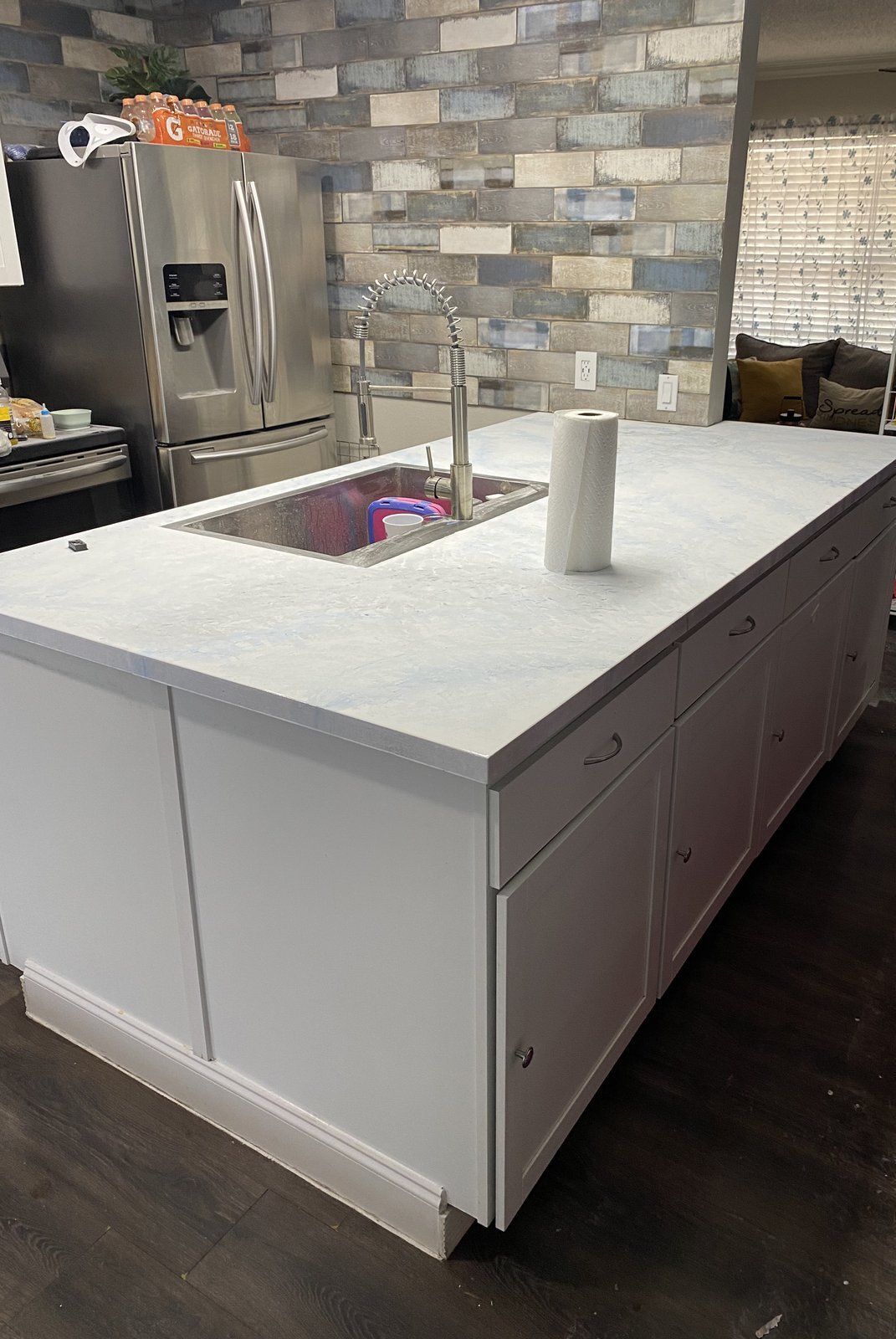
Quick Answer: That white, stone-looking kitchen island isn’t a slab. It’s epoxy: a white epoxy from Lone Star Decorative, a local San Antonio supplier, with blue and silver metallic highlights, poured over butcher block and finished matte. The bathroom vanity was granite the customer didn’t like, coated with the same white epoxy for a gray-veined look. The catch: what’s underneath matters. Wood has to be dealt with before epoxy, and the top has to be solid, with any repairs done first. Epoxy isn’t a repair.
I’m Master Tech Scott with HomeWise Services. Most folks around San Antonio know me for appliance repair, but I also do epoxy countertops, floors, and decorative concrete. Here’s a kitchen island reveal and a bathroom vanity, plus what to know before you call anyone about a countertop.
What’s on this kitchen island?

- The epoxy: a white epoxy from Lone Star Decorative, a local San Antonio supplier.
- The highlights: blue and silver metallic, worked into the white.
- The method: I blended it with a roller brush, then used isopropyl alcohol for the dispersion effects.
- Underneath: two joined butcher block countertops.
- The finish: matte. Every photo and clip of this island shows the final sanded, matte-sealed top.

Up close, the movement is what sells it. Every pour moves differently, so no two tops come out the same.
What went wrong on this island, and why it’s matte
I’ll be straight with you. This island is two joined butcher block countertops, and the wood held moisture. The day after the pour, that trapped moisture came up through the epoxy, and the top bubbled up with craters all over it. I sanded it down and sealed it to a matte finish, and that’s the top you see in these photos.
The lesson: wood has to be dealt with before epoxy goes on it. Bare wood can hold moisture you can’t see, and it has to come out somewhere. That’s a big reason countertop epoxy is a pro job, and why I want to look at your top in person before anything gets poured.
Don’t like your granite? You can coat over it

This double-sink vanity was granite. The customer didn’t like how it looked but didn’t want to buy new granite. So I scuffed the granite with very coarse sandpaper to give the epoxy something to grab, then coated it with the same Lone Star Decorative white epoxy as the island, poured for a gray-veined look right up to the undermount sinks.
Same epoxy, different pour, different look. That’s what I mean when I say every pour moves differently. If your granite is solid but you’re tired of how it looks, coating over it is an option to ask about at the consult.
Can my countertop get this look?
Often, yes. Many countertop epoxy systems are designed to go over existing surfaces. For example, Leggari’s Metallic Epoxy data sheet lists laminate/Formica, stone and engineered stone, tile, concrete, and wood. I walked through that in detail in Can You Epoxy Over Existing Countertops?
What matters most is the condition of the top. That same data sheet says the substrate must be structurally sound and the surface properly prepped, with any necessary repairs done first. Take a quick look at yours:
- Press around the sink and dishwasher. Swelling or soft spots mean water has gotten into the base.
- Tap any tile. Loose or hollow-sounding tiles need attention first.
- Check laminate edges. Peeling or lifting edges are a sign of trouble underneath.
- Look for cracks. A cracked or moving top gets fixed before anything is coated.
Any of those means the repair comes before the coating. A coating goes on top of what’s there. It won’t fix a rotten or moving base.
Why isn’t this a DIY weekend project?
Prep decides most of the result (this island proves it), and epoxy is a real chemical product with real hazards. Manufacturer data sheets, Leggari’s included, call for gloves, eye protection, and a respirator, and warn that mixed epoxy can heat up. Getting blends and dispersion like this also takes practice. Leave the pour to someone who does it.
How do I get started?
- Ask your questions in the HomeWise app: homewiseservices.grok.me
- Book the in-person consult. Starting in November, coatings consults are $100, in person, on weekday mornings from 8 AM to noon. I come out, look at your countertop, and build a custom mockup of what it could look like in your space. If you hire HomeWise, the $100 goes toward the job.
FAQ
Is this epoxy countertop real stone?
No. It’s white epoxy with blue and silver metallic highlights over butcher block, in a matte finish.
What epoxy did you use, and what’s underneath?
Both are a white epoxy from Lone Star Decorative, a local San Antonio supplier. The island is poured over two joined butcher block countertops, with blue and silver metallic highlights, blended with a roller brush and isopropyl alcohol, then sanded and sealed to a matte finish. The vanity is the same white epoxy over the customer’s existing granite, poured for a gray-veined look.
Can you put epoxy over granite?
Yes. That’s what this vanity is. The granite was scuffed with very coarse sandpaper for adhesion, then coated. Whether yours is a good candidate is something I check at the consult.
How much does an epoxy countertop cost?
It depends on your countertop’s size, shape, and condition, so I don’t quote without seeing it. That’s what the $100 in-person consult is for.
Does the $100 consult fee count toward the job?
Yes. If you hire HomeWise, the $100 goes toward the job.
How long before I can use my countertop?
It depends on the product and conditions. I’ll give you the real schedule for your job at the consult.
Want this look on your countertop?
📅 Book online now: https://squareup.com/appointments/book/LP9TG4BA7WG6C
Sources: Leggari Metallic Epoxy Technical Data Sheet (general prep and safety guidance). Photos: HomeWise Services.
Scott, HomeWise Services, (210) 580-6670
20710 Huebner Rd, San Antonio, TX 78258. Serving San Antonio and the area within 30 miles.
Appliance repair and decorative concrete/epoxy coatings (Leggari Certified Installer).
This article is general information, not a professional assessment.

Leave a Reply