
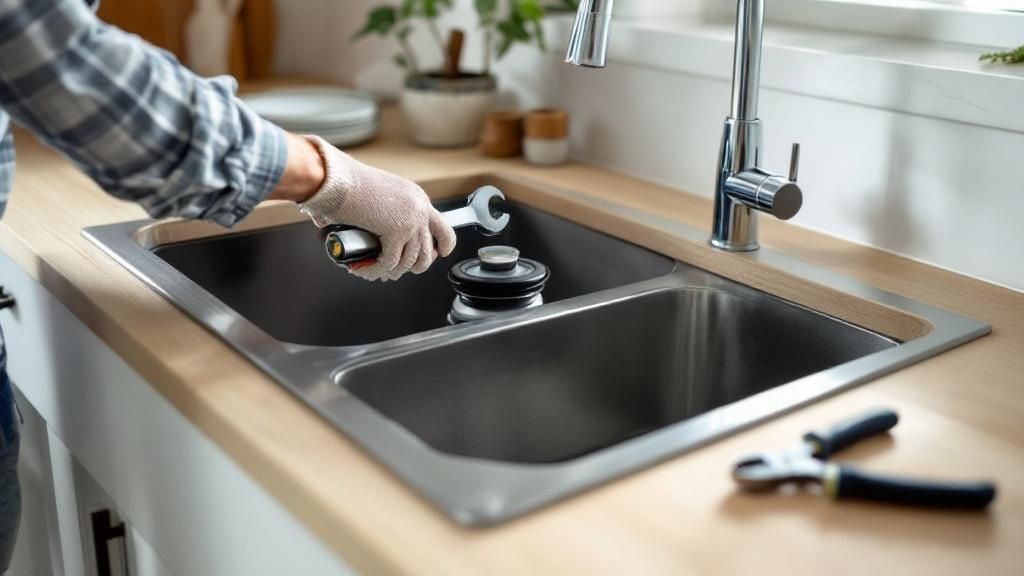
When your garbage disposal goes on strike, it can throw your whole kitchen routine into chaos, a common frustration for Austin homeowners. Thankfully, you don’t have to be a master plumber to figure out what’s wrong. Is your disposal humming, silent, or leaking? Before you attempt a DIY fix, what if you could connect with a master technician for just $20? That’s the white-glove solution HomeWise Services offers. Our unique concierge service gives Austin residents a direct line to expert troubleshooting for appliance, AC, and plumbing repairs, helping you diagnose the issue, find the right parts, and even schedule a repair. For those who prefer instant online advice, JustAnswer is another great resource. Let’s dive into how you can solve this common plumbing repair issue yourself.
Your Quick Fix Guide for Common Disposal Problems
A garbage disposal that’s humming, silent, or dripping is sending you a signal. Before you can fix it, you need to know what it’s trying to tell you. Think of this as your decoder ring for whatever is happening under your sink.
Each symptom points to a different culprit, and your first move depends entirely on what you see, hear, or don’t hear. Is the motor humming but the blades aren’t moving? That’s a classic jam. Is it completely dead, with no sound at all? You’ve probably got a power problem. And if you spot that dreaded puddle forming in the cabinet below, it’s time to hunt down a leak.
Diagnosing Your Garbage Disposal Issue at a Glance
To make it even easier, here’s a quick-glance table. Use it to match your disposal’s symptoms to the most likely cause and figure out your first step.
One thing before you start: always cut the power to the unit first. Whether you unplug it from the wall or flip the breaker, this is the single most important safety step. No exceptions.
| Problem | Likely Cause | First Action (After Cutting Power) |
|---|---|---|
| Humming, No Grinding | The impeller blades are blocked by a hard object like a fruit pit, bone, or utensil. | Use a hex wrench on the bottom of the unit to manually turn the blades back and forth. |
| No Sound, No Action | The unit has lost power due to a tripped internal breaker or a tripped home circuit. | Press the small red or black reset button on the bottom of the disposal housing. |
| Water Dripping | A seal has failed at the sink flange, dishwasher hose, or main drain pipe connection. | Dry the entire unit, then run water to pinpoint the exact source of the leak. |
Getting this initial diagnosis right is everything. It’s the difference between a five-minute fix you can handle yourself and a problem that might mean calling in the cavalry. For most Austin homeowners, just knowing what you’re up against is half the battle.
Expert Insight: The biggest mistake I see people make is panicking and assuming the motor is shot. A humming disposal sounds final, but 9 times out of 10, it’s just a simple jam. You can usually clear it in minutes with the little wrench that came with the unit.
Feeling a little out of your depth or just want a second opinion? That’s exactly why we set up the HomeWise Services concierge service. For just $20, you can connect with a HomeWise master technician to troubleshoot your appliance, AC, or plumbing issue, get part recommendations, and schedule a white-glove repair in Austin, TX. Book now: Schedule Your Concierge Call. We’ll help you find the problem, tell you what to do next, and if needed, schedule a professional for plumbing repair in Austin on the spot.
Start with Safety Before Any Repair
Before you even think about reaching under that sink, we need to have a serious talk about the most critical part of this job: safety. I know you want to jump right in and get that disposal working again, but trust me on this—a garbage disposal is a powerful machine with some seriously sharp parts. Accidentally turning it on while you’re working is a huge risk, but it’s one you can completely avoid.
Now, just flipping the wall switch next to your sink isn’t enough. It’s a good start, but it’s not foolproof. Switches can fail, or worse, a family member who doesn’t know you’re working could flip it back on. To make absolutely sure there’s zero power going to that unit, there are two non-negotiable steps you have to take.
Disconnect Power at Two Points
First, go ahead and flip the wall switch for the disposal to the “Off” position. This is your first line of defense.
Next, and this is the most important part, walk over to your home’s main electrical panel. Find the circuit breaker that controls your kitchen—it’s usually labeled “Kitchen,” “Disposal,” or something similar. Flip that breaker all the way to the “Off” position. This physically cuts the electrical current, making it impossible for the disposal to start up.
A Pro’s Warning: I can’t tell you how many horror stories start with, “I thought just flipping the switch was enough.” I’ve heard from DIYers who had someone else turn the disposal on while their hands were inside. Always, always kill the power at the breaker box. That extra minute is the only way to be 100% certain you’re safe.
Gear Up with the Right Protection
With the power completely off, your next move is to protect yourself from what’s inside the disposal. Even when it’s off, the grinding chamber can have sharp metal edges or be hiding things like broken glass.
Here’s the simple gear you absolutely need:
- Safety Glasses: This is non-negotiable. Debris can easily get knocked loose and fly out while you’re working. Your eyes are too important to risk.
- Heavy-Duty Gloves: Forget the thin latex or dish gloves. You need a pair of thick, puncture-resistant work gloves to shield your hands from any sharp objects lurking unseen in the chamber.
Taking these precautions is what separates a successful weekend fix from a trip to the ER. It lets you tackle the problem with confidence, knowing you’ve handled the biggest risks before you even start.
If you’re an Austin homeowner and feel even a little unsure about finding the right breaker—or just want an expert eye to confirm you’re good to go—our $20 HomeWise concierge service is perfect for this. A master technician can hop on a quick video call to walk you through the safety check, giving you complete peace of mind to fix your garbage disposal.
How to Clear a Jammed Garbage Disposal
We’ve all heard it. That awful, high-pitched humming sound when you flip the disposal switch, but nothing grinds. It’s the classic sign of a jammed garbage disposal, one of the most frequent kitchen plumbing headaches I see in Austin homes. The good news? It’s usually a pretty straightforward fix you can handle yourself.
A jam occurs when something gets wedged between the spinning impeller blades and the grinding chamber wall. Think small, hard items like a popcorn kernel, a stray chicken bone, or even a piece of silverware that took a dive. The motor is trying its best to turn—that’s the humming—but the blades are stuck solid. Your job is to free them up.
The Best Tool for the Job: A Disposal Wrench
The safest and most effective way to tackle this is from underneath the sink. Most disposals come packed with a small, double-ended Allen wrench made specifically for this task. If you’ve misplaced yours (and who hasn’t?), a standard 1/4-inch hex wrench will almost always do the trick.
First things first: kill the power to the disposal at your circuit breaker. This is non-negotiable.
Once you’re sure the power is off, get under the sink and look for a small, hexagonal hole right in the center of the unit’s base. This is your access point to the manual crank.
Stick the wrench in and start working it back and forth. You’ll need to use some firm, steady muscle. Rock it clockwise, then counter-clockwise, repeating this motion. This forces the impeller blades to move manually, which is usually enough to crush or dislodge whatever is causing the blockage. You might even hear a satisfying clink or crunch as the object breaks free.
This is what it looks like in action:

That back-and-forth motion is the secret. It gives you the leverage to break the jam without putting a ton of stress on the motor itself.
What to Do If You Don’t Have a Wrench
If your wrench is long gone and you don’t have a hex set handy, you can try to clear the jam from the top—but you need to be extremely careful.
Again, make 100% sure the power is off at the breaker. Then, grab a flashlight and peer down into the disposal drain. Look for the offender. It’s often a fruit pit, a bottle cap, or the tell-tale glint of metal from a fork or spoon.
A Word of Caution: Never, ever put your hand inside the garbage disposal. Even with the power disconnected, those blades are incredibly sharp.
Instead, grab a pair of long-handled tongs or pliers. Carefully reach in and try to pull the object out. If you can’t get a good grip, a sturdy wooden spoon or even the end of a broom handle can work in a pinch. Use it to push against one of the blades, rocking it back and forth just like you would with the wrench.
Once you think the jam is cleared, use your tongs to fish out any loose bits. Now, turn the cold water on, head back to the breaker to restore power, and then give the disposal switch a quick flip. If it whirs to life, congratulations—you’ve just fixed your own disposal.
Getting the Right Parts and Expert Help
Losing that little wrench is incredibly common. If you need a replacement, they’re easy to find online.
- Find a new garbage disposal wrench at RepairClinic.
- Order universal and brand-specific parts from Sears PartsDirect.
If you’ve tried these methods and the unit still just hums, or if you’re just not comfortable doing this yourself, don’t force it. For just $20, the HomeWise Services concierge can get you on a video call with a master technician in Austin to confirm the problem and schedule a pro if needed.
And for those moments you need an answer right away, you can get fast, reliable advice from a verified expert. Try JustAnswer and connect with an expert for just $5 to get your problem solved in minutes.
What to Do When Your Disposal Won’t Turn On
You flip the switch, ready for the familiar grind, but all you get is silence. No hum, no buzz, nothing. When a garbage disposal goes completely dead like this, it’s almost always a power issue. Unlike a humming sound, which points to a jam, total silence tells you the electricity isn’t getting to the motor. The good news? The most common reasons are surprisingly simple to fix yourself.
Usually, this “dead in the water” scenario is just a built-in safety feature doing its job. Disposals have an internal circuit breaker that trips to prevent the motor from burning out when it’s overloaded or jammed. Finding and resetting it is often all it takes to get back in business.

First, Check the Reset Button
Before you go hunting for your home’s main breaker box, take a look at the unit itself. Get down and check the very bottom of the disposal. You’re looking for a small, slightly recessed button, usually red or black. This little guy is the overload protector—the reset button.
If the button has popped out (it’ll stick out by about a quarter of an inch), the disposal’s internal breaker has tripped. This happens all the time, especially right after you’ve cleared a tough jam or if the motor was struggling.
Here’s the simple fix:
- Make sure the disposal’s wall switch is in the “Off” position. Safety first.
- Firmly press the reset button. You should feel it click back into place and stay flush with the housing.
- Turn on the cold water, then flip the wall switch back to “On.”
If the disposal roars back to life, you’re all set. If the button refuses to stay in or trips again right away, you might be looking at a more stubborn jam you haven’t fully cleared, or a potential issue with the motor itself.
Next, Look at Your Main Breaker Panel
Okay, so the reset button wasn’t the culprit, or pressing it did nothing. Your next stop is the main electrical panel for your house. A really tough jam or a random power surge can sometimes trip the circuit breaker that controls your kitchen outlets.
Scan your panel for a breaker switch that’s no longer in the “On” position—it might be in the middle or flipped completely to “Off.” It should have a label like “Kitchen,” “Disposal,” or “Kitchen Outlets.” To reset it, you have to push the switch firmly all the way to the “Off” position first, and then flip it back to “On.”
Expert Takeaway: If the breaker at your main panel trips repeatedly, stop resetting it. This is a serious red flag. It indicates a potentially dangerous electrical fault in the disposal or the circuit wiring, and it’s time to call in a pro.
This is a perfect time to use our $20 HomeWise concierge service. A master technician can talk you through the issue safely, helping you figure out if it’s a simple reset or something that needs a licensed plumber in Austin to investigate.
When to Suspect a Faulty Switch or Wiring
What if both the reset button and the circuit breaker are fine, but the disposal is still dead? The problem could be the wall switch you flip every day or an issue with the wiring connecting it to the unit. Diagnosing these problems requires tools and a good understanding of how to work with electricity safely. For the vast majority of Austin homeowners, we strongly advise against DIY electrical work. It’s just not worth the risk. The global garbage disposal market is valued at around $4.2 billion. As manufacturers add features, the internal electronics get more complex. You can learn more about these market trends and their impact on repairs, but the key takeaway is that modern disposals aren’t as simple as they used to be. A HomeWise Services expert can safely find out if you just need a new wall switch or if there’s a more serious wiring problem that needs a licensed professional’s touch.
How to Fix a Leaky Garbage Disposal in Austin Homes
Ah, the dreaded puddle under the kitchen sink. It’s a classic homeowner rite of passage, and it’s never a fun one. When you spot that murky water, you know you’re dealing with a leaky garbage disposal. This isn’t just a minor annoyance; left unchecked, it can quickly lead to warped cabinets, ruined flooring, and even mold. The trick is to act fast and play detective to find the source of the drip.
Before you can even think about a fix, you have to know exactly where the water is coming from. Start by thoroughly cleaning and drying the entire outside of the disposal with a towel. Then, plug your sink, fill it with a few inches of water, and pull the stopper. With a flashlight in hand, watch closely as the water drains. You’re looking for the very first drop to appear.
Leaks almost always pop up in one of three spots. By checking each one methodically, you can pinpoint the problem and get to work on the right solution for your plumbing repair.
Checking the Sink Flange Connection
The most common culprit is right at the top, where the disposal unit meets the sink drain. This connection is sealed by the sink flange and gaskets. With all the vibration from the motor, it’s no surprise that this seal can loosen or just wear out over time. If you see water weeping from the top of the disposal’s body, this is your prime suspect.
- Tighten the Mounting Bolts: Your first move should be to grab a screwdriver and tighten the three mounting screws on the ring. Turn each one a little at a time, alternating between them to apply even pressure. Sometimes, that’s all it takes.
- Replace the Gasket or Putty: If tightening doesn’t solve it, the seal itself has likely failed. This is a bigger job. You’ll need to disconnect the plumbing, drop the disposal down, and replace the plumber’s putty or the gasket that sits between the sink flange and the basin.
Investigating the Side Dishwasher Hose
Another very common leak point is the side inlet where the dishwasher drain hose connects. It’s usually held in place by a simple metal clamp. A leak here is pretty obvious—you’ll see water dripping right from that hose connection. This is often just a case of the clamp working its way loose. To fix it, just take a screwdriver or a nut driver and tighten the clamp until it’s good and snug. Don’t go overboard, though. Overtightening can easily crack the plastic hose or the disposal’s inlet port.
Expert Insight: Before you tighten that clamp, double-check that the rubber hose is pushed as far onto the disposal’s inlet as it will go. A clamp that’s only grabbing the very edge of the hose is practically an invitation for a leak.
Examining the Main Drain Pipe
The last place to look is at the very bottom, where the disposal’s discharge pipe connects to your home’s main drain line. This connection uses a gasket and two bolts to keep everything sealed tight. If you spot drips coming from this large elbow pipe, the bolts might be loose, or the internal gasket has seen better days. Start by trying to tighten the two bolts holding the pipe in place. If the drip continues, you’ll need to swap out the gasket.
- Find a new gasket from a trusted supplier like Parts Select.
- Order specific seals and putty from Reliable Parts.
In North America, the food waste disposer market is a big one, valued at USD 840 million. You can read more about the U.S. food waste disposer market to see why getting the right parts is so critical.
If you’ve tightened every connection and you’re still chasing a drip, take a close look at the main body of the disposal. If you see water coming from a crack in the housing itself, I’m afraid it’s game over. The unit has reached the end of its road, and a full replacement is your only real option.
For Austin homeowners who’d rather skip the guesswork, the $20 HomeWise concierge service is a great shortcut. A master technician can help you find the leak over a video call and tell you what to do next, whether it’s a simple fix or time to schedule a professional plumbing repair service in Austin.
Austin Homeowner FAQs for Garbage Disposal Repair

Even with the best instructions, you’re going to have questions. Getting a straight, reliable answer can be the difference between a five-minute fix and a five-hundred-dollar mistake. This FAQ section is designed to tackle the most common questions we get from Austin homeowners at HomeWise Services.
What Should I Never Put Down My Garbage Disposal?
This is, without a doubt, the most important question. To keep your disposal humming along, you need to make sure you never put these items down the drain:
- Fibrous Vegetables: Things like celery, corn husks, onion skins, and asparagus are notoriously stringy. They don’t grind; they wrap around the blades and can bring the motor to a screeching halt.
- Grease, Oil, and Fats: These might seem harmless when they’re hot liquid, but they cool and solidify inside your pipes, creating stubborn plumbing clogs.
- Coffee Grounds and Eggshells: Coffee grounds clump together like wet sand and can create dense sediment clogs. The thin membrane on eggshells can get sticky, clinging to the blades and pipe walls.
- Expandable Foods: Pasta and rice love to soak up water and swell, creating a dense, glue-like clog.
- Large Animal Bones: Most disposals can handle the occasional small chicken or fish bone, but thick, hard bones from beef or pork are just too much for a residential motor to grind.
If you’re ever on the fence about what’s safe for your specific model, our $20 HomeWise concierge service can connect you directly with a technician for some personalized advice.
How Can I Clean My Disposal and Get Rid of Odors?
A funky-smelling disposal is a common complaint, but thankfully, it’s usually an easy fix. A simple and surprisingly effective cleaning trick just requires ice cubes and citrus peels. Just fill the disposal about halfway with ice cubes, toss in a few lemon or orange peels, then turn on the cold water and run the unit.
Expert Tip: The ice acts like a powerful scrubber, scouring away all that stuck-on gunk from the blades and chamber walls. At the same time, the natural oils in the citrus peels work as a potent, fresh-smelling deodorizer.
If that smell just won’t go away, it could point to a deeper problem, like a blockage down in the p-trap. A stubborn odor is often a sign it’s time to have an expert take a look.
Is It Worth Repairing an Old Garbage Disposal?
As a general rule of thumb, if your garbage disposal is more than 8–10 years old and the repair is going to cost more than half the price of a brand-new unit, replacement is usually the smarter financial decision. A HomeWise Services technician can give you an honest assessment for your Austin home, helping you weigh the costs and benefits so you can make a call you feel good about. The global waste management market is set to hit USD 1.35 billion by 2025, which shows just how much homeowners are relying on these appliances. You can learn more about the growing importance of waste management solutions and see why keeping these units in top shape is a key part of modern homeownership.
Why Is My Disposal Making a Loud Metallic Noise?
That sudden, loud, rattling, or metallic grinding sound almost always means something that isn’t food has fallen into the unit. The second you hear that noise, shut the disposal off immediately. Flip the wall switch off and cut the power at the circuit breaker. Now, grab a flashlight and peek inside the chamber. Use a pair of pliers or tongs—never your hands—to carefully fish out the foreign object. If you can’t see anything, the internal parts may already be damaged, and that’s a job for a professional.
Dealing with garbage disposal problems doesn’t have to be a major headache. Whether you just need a quick answer, a safe walkthrough for a DIY fix, or a pro on-site, HomeWise Services is here to help Austin homeowners. For just $20, our concierge service connects you with a master technician for personalized advice and easy service scheduling. And if you need an answer right now, Try JustAnswer and connect with an expert for just $5.
Ready for some expert help? Visit HomeWise Services to book your concierge call or schedule a white-glove repair in Austin today!
Article created using Outrank
Leave a Reply